Google's SIMA 2: Revolutionizing AI with Advanced 3D World Interaction and Self-Improvement
November 13, 2025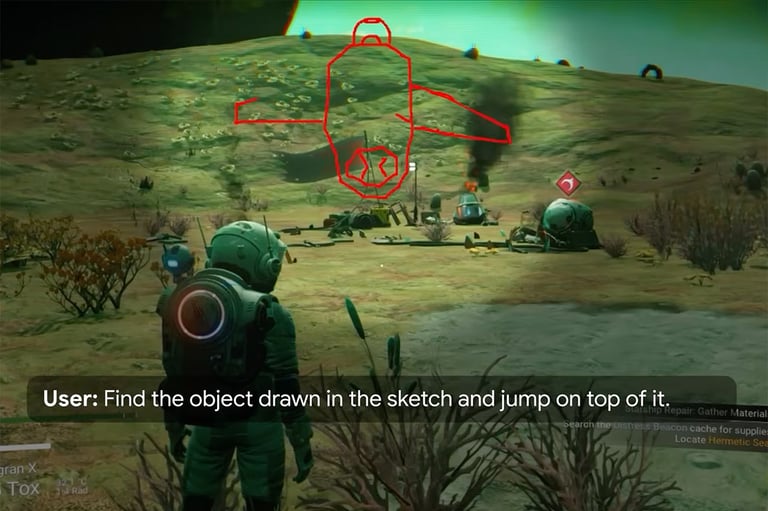


Despite advances, SIMA 2 still struggles with very long tasks and maintaining memory in a limited window, and can face visual interpretation challenges.
The potential real-world impact hinges on translating virtual-world capabilities into physical robotics through strong world understanding and reasoning.
Future implications include AI co-players in open-world games, smarter NPCs, and training grounds for real-world robotics, plus universal language-to-action assistants for digital environments.
SIMA 2 is Google's upgraded AI agent that can act, learn, and reason inside 3D virtual worlds, functioning as a co-player that understands prompts, discusses plans, and improves over time.
The system benefits from large-scale demonstrations from partners and can start new tasks in unfamiliar environments, like MineDojo, by leveraging its learned planning and communication.
Self-play data helps train later versions, with ongoing work to tackle longer tasks, memory, precise control, and complex 3D scene understanding.
In related news, Marble, a generative world model, creates 3D worlds from text, images, or video and supports interactive editing.
The work illustrates progress toward more general AI systems capable of adapting to new tasks and environments, with implications for future robotic agents that learn with minimal human intervention.
DeepMind identifies gaps such as a limited memory window, difficulty with very long multi-step tasks, and challenges in 3D visual interpretation.
It handles long, multi-step tasks and multimodal prompts—including sketches, multiple languages, and emojis—and can transfer concepts across games, such as mining concepts moving to harvesting.
SIMA 2 serves as a testbed for robotics-relevant skills and navigation, signaling a strong research path toward practical robotics applications and broader AGI potential.
Experts emphasize the broader significance: the approach centers on self-guided learning, continuous improvement, and the potential to transfer to real-world robotics through better navigation, tool use, and teamwork.
Limitations include struggles with long-horizon planning, precise low-level actions, robust visual understanding, and a constrained memory window.
DeepMind envisions real-world robotics use, emphasizing that high-level understanding plus low-level action control are needed for autonomous operation.
The Gemini model underpins SIMA 2, enabling interpretation of goals, task reasoning, action explanations, and self-assessment, with training boosted by human demonstrations and Gemini-generated labels.
Core architecture centers on Gemini for instruction interpretation, goal understanding, and action planning.
Access is restricted to a research preview for a small group, with oversight of self-improvement and requests for interdisciplinary feedback to ensure responsible development.
The broader goal is progress toward artificial general intelligence, with challenges in understanding user intent, planning effectively, and applying common-sense reasoning.
SIMA 2 is being released as a limited research preview to select academics and game developers, stressing responsible development and collaboration.
Current scope positions SIMA 2 as a research preview, not a consumer tool, tested with academics and game developers under controlled conditions due to self-learning capabilities.
It can interpret user visuals or shapes and operate in AI-generated 3D worlds created by Genie, adapting to entirely new environments.
Researchers involved include Joe Marino, Jane Wang, and Frederic Besse, building on DeepMind's prior work like AlphaFold and SIMA 1 unveiled in 2024.
Compared to SIMA, SIMA 2 adds thinking about commands and greater flexibility, expanding the skill set beyond the original 600 defined actions.
In fresh environments, SIMA 2 quickly orients, analyzes surroundings and goals, and applies prior concepts to new tasks like transferring mining ideas to harvesting.
SIMA 2 achieves a higher task completion rate than SIMA 1 and shows stronger generalization in Genie 3-generated 3D environments.
Specifically, SIMA 2 reaches around two-thirds task completion in tests, significantly outperforming SIMA 1 and approaching human-level performance.
A key innovation is self-improvement: SIMA 2 uses Gemini to generate new tasks and a reward model to evaluate attempts, reducing reliance on human data.
SIMA 2 demonstrates stronger generalization across virtual environments, tackles longer tasks, and can interpret high-level goals, explain steps, and collaborate with humans or other agents.
Embodied intelligence applications are a focus, with skills in navigation, tool use, and collaborative task execution supporting broader embodied AI research.
Pairing SIMA 2 with Genie 3 allows generation and navigation of real-time 3D environments from images or text, enabling goal-directed actions in unseen worlds.
The reports highlight that SIMA 2 bridges games and real applications by handling complex interactions and goal pursuit, illustrating the learning potential for real objects and environments.
When combined with Genie 3, SIMA 2 can navigate automatically generated 3D worlds from text or images, following user prompts without prior exposure.
Self-improvement and iterative learning enable SIMA 2 to generate experience data autonomously after initial demonstrations, aiding future versions.
In sum, SIMA 2 expands the range of skills beyond SIMA by adding reasoning and flexible world interaction.
Tests show improved generalization across unfamiliar games like ASKA and MineDojo, transferring concepts such as mining between environments.
Summary based on 8 sources
Get a daily email with more Tech stories
Sources

Business Standard • Nov 14, 2025
Need a co-player in video games? Google's SIMA 2 shows how AI could help
Analytics India Magazine • Nov 14, 2025
Google DeepMind Unveils SIMA 2, an AI Agent That Acts and Learns in 3D Environments
SiliconANGLE • Nov 14, 2025
Google DeepMind's SIMA 2 agent learns to think and act inside virtual worlds - SiliconANGLE
TechEBlog • Nov 13, 2025
Google DeepMind's SIMA 2 Steps Into the Game, Virtual 3D Worlds That Is