Germany Passes Record 2026 Budget Amidst Criticism Over High Debt and Allocation Concerns
November 28, 2025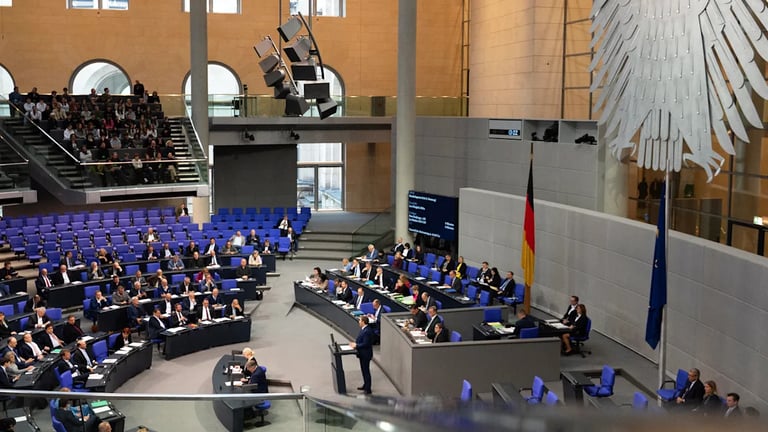


Discussions continue on social impacts, municipal austerity, and the Infrastructure Fund’s potential for future investments amid broader political contention.
Core investments target infrastructure, digital administration, childcare, education, and the Bundeswehr to foster long-term growth rather than immediate consumption.
AfD-led opposition argues the debt increase and use of special funds violate constitutional norms and calls for a different approach and governance.
Deficits are expected to widen in coming years due to higher interest payments, making tax burden distribution a central political issue.
Social and labor spending dominates the budget, with pension subsidies rising and some benefits to Bürgergeld adjusted, plus commuter incentives and EV subsidies for lower- and middle-income households.
A large share of spending goes to labor and social programs, including health and long-term care insurance, stressing public finances.
Debt-to-GDP is around 64%, with projections suggesting a rise toward 85% in ten years, highlighting ongoing fiscal sustainability debates.
High-profile budget debates culminate in a forthcoming cabinet and chancellor address, signaling a major parliamentary session.
Some ministries report savings through reallocations, with limited overall reductions, while the Development Ministry’s budget is trimmed by a modest amount.
Defense remains a priority, continuing substantial outlays and Ukraine support as core budget themes.
Klingbeil calls the 2026 budget a warm-up for 2027 and 2028, signaling planned talks on tax increases and subsidies as part of forthcoming savings.
Looking ahead, deficits are projected to widen in 2027 and beyond, with substantial gaps anticipated for 2028 and 2029, underscoring long-term sustainability concerns.
Transport investment leads the package, with a combination of core budget and a debt-financed fund earmarked for roads, bridges, and rail, plus a boosted Autobahn budget.
The budget underscores transportation as the top investment priority, supported by a mix of core funds and debt-financed infrastructure investments.
A constitutional amendment allowed defense spending to bypass the debt brake, a move supported by the Union and SPD.
Critics call for closing tax loopholes and wealth taxes to address inequities, while opposing parties focus on reducing living costs for the broad public.
Defense spending peaks at about 108 billion euros, with Ukraine aid totaling 11.5 billion euros, funded largely by loans from special funds.
The 2026 debt climbs to roughly 180 billion euros, marking the second-largest post-war annual increase, driven by defense spending and the dedicated infrastructure fund.
Officials describe the revised budget as expansionary borrowing to spur recovery, the largest in the post-pandemic era and framed as investment rather than consumption.
CDU/Union argue for targeted growth investments and prudent, results-oriented spending in education, research, digitalization, and transportation, warning against perpetual deficits.
The budget debate reveals divergence: opposition highlights deficits and misallocation; the coalition emphasizes modernization and long-term growth.
Greens criticized the process as opaque, warning that large armament contracts lack parliamentary oversight and citing costs in modernization projects as problematic.
Opposition parties, including AfD, Greens, and Die Linke, criticized the budget for high debt and questionable allocations, urging more spending on housing, education, childcare, and municipalities.
The budget faces criticism that debt is being used for giveaways rather than growth, with emphasis on reform and accountability.
The coalition faces growing fiscal strain, with questions about tax equity and wealth taxation becoming more prominent.
An interview sets a cautiously optimistic tone: benefits could exceed costs if debt-financed investments are wisely used to modernize infrastructure and boost growth.
Advocates call for accompanying fiscal reforms to ensure sustainability, such as reducing pension subsidies, raising retirement age, boosting labor participation, and encouraging skilled immigration.
An EH55 climate-focused home efficiency program starts mid-December to promote energy-saving heating, while uncertainty remains over VAT reductions being passed to diners.
DIW’s Dany-Knedlik argues younger generations will benefit if fresh credit funds additional investments rather than current spending.
The ruling coalition prioritizes stimulus, infrastructure modernization, climate neutrality, and strengthening the military in response to perceived threats.
The government highlights over 120 billion euros in rail, road, and defense investments to tackle lagging infrastructure and reassure security guarantees.
Germany’s Bundestag approved the 2026 federal budget with total expenditures of about 524.5 billion euros, financing a core budget net borrowing near 98 billion euros and more than 180 billion euros when including the Defense and Infrastructure Special Funds.
The budget is portrayed as a compromise that satisfies multiple parties’ priorities without major immediate concessions.
Critics warn that the borrowing’s impact may be temporary without reforms and caution against using funds for day-to-day spending rather than long-term investments.
Citizen-focused measures include a higher commuter tax deduction, a consumer premium for EV purchases, and energy-efficient home grants, with uncertain pass-through of lower restaurant VAT.
Merz’s government shifted away from strict debt rules by exempting most defense spending from the debt brake and launching an infrastructure fund.
SPD Finance Minister Klingbeil defends the budget as future-oriented investments in resilience, infrastructure, digitalization, climate protection, and education, while acknowledging the need for reforms.
Klingbeil frames the budget as an investment plan that reduces bureaucracy, maintains growth competitiveness, and signals a pathway to fiscal improvement post-G20.
The government presents the budget as a modernization-and-growth package, with defense spending preserved and Ukraine aid increased.
Analysts estimate the 2026 expansionary impulse could lift GDP modestly, with continued growth possible in subsequent years if investments pay off.
IW Köln suggests about half of new spending is redirected from its stated purpose, fueling concerns about misallocation.
The budget aims to revive Germany’s economy through investment while sustaining defense spending and increasing Ukraine assistance by several billion euros.
Despite high borrowing, the debt brake remains technically intact due to loosened rules for defense and other measures.
Greens and Left argue that nearly half of new borrowing goes to non-investment or consumption, with the Infrastructure Fund used as a substitute for real investments.
A large share of funds goes to military procurement, including ammunition, with Ukraine receiving a significant portion of defense-related spending.
The Transport Ministry allocates the most to infrastructure, including substantial debt-financed funds for roads, bridges, and rail.
Summary based on 18 sources
Get a daily email with more World News stories
Sources

Investing.com • Nov 28, 2025
German parliament approves 2026 budget with $208 billion in new debt
Channels Television • Nov 28, 2025
Germany Passes Budget With Vast New Borrowing