Philips Unveils AI-Powered Verida CT at RSNA 2025: A Game-Changer in Spectral Imaging
November 30, 2025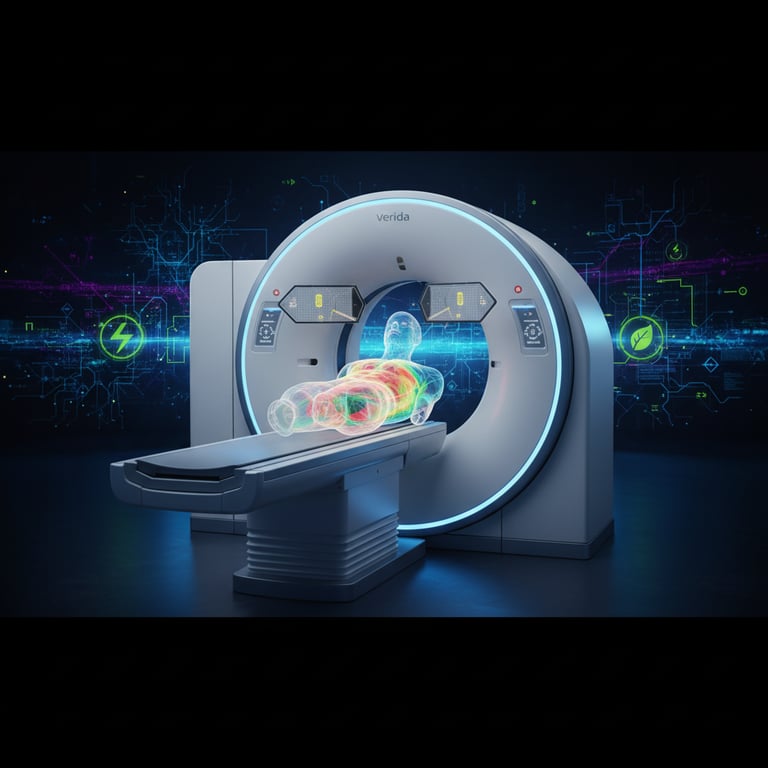

Regulatory and market milestones over the next 6 to 18 months include pursuing U.S. 510(k) clearance, generating independent clinical performance data, and reporting early throughput in routine practice.
Clinically, Verida could reduce invasive procedures and boost diagnostic confidence, with adoption hinging on real-world validation and regulatory clearance.
Notes clarify that energy savings exclude system preparation energy and that regulatory clearance status will govern use in different regions.
Clinical endorsements, including from Prof. Eliseo Vaño Galván, suggest spectral imaging could become routine in cardiac CT and potentially reduce invasive angiograms, with broader applicability elsewhere.
A cardiovascular radiologist highlighted that spectral imaging may become standard in cardiac CT, improving diagnostic confidence and reducing invasive angiography across multiple areas.
Testimonials, including from Prof. Vaño Galván, praise Verida for diagnostic confidence gains in cardiac imaging while noting photon-counting CT remains more research-focused.
Regulatory status: CE-marked; 510(k) pending in the U.S.; not yet sold in the U.S., with limited market availability expected to begin in 2026.
Verida builds on Philips’ spectral CT legacy—CE-marked with 510(k) pending in the U.S.—and follows more than 800 peer-reviewed papers and installations.
Technical performance includes up to 145 images per second and whole-exam times under 30 seconds, enabling as many as 270 exams per day in high-throughput settings.
AI integration across the imaging chain yields lower noise, higher image quality, and faster exams, with spectral imaging enabling material differentiation beyond conventional CT.
Verida is Philips’ detector-based spectral CT powered by AI, unveiled at RSNA 2025, designed to transform CT imaging by optimizing acquisition, reconstruction, and workflow while reducing dose.
The system aims to streamline radiology workflows, cut repeat scans, standardize spectral imaging across care pathways, and could cut energy use by up to 45%.
Philips positions Verida as a software-defined CT solution that prioritizes workflow efficiency, image sharpness, and consistency across care pathways.
Hardware combines a third-generation Nano-panel dual-layer detector with Spectral Precise Image AI reconstruction and AI-driven noise reduction to deliver fast, dose-efficient spectral reconstructions.
The system uses Philips’ dual-layer spectral detector plus AI reconstruction to provide spectral outputs from a single scan, harnessing Spectral Precise Image technology for noise reduction.
Philips executives frame Verida as a new standard for image quality and speed, aimed at streamlining radiology workflows and improving outcomes, especially in cardiac imaging.
Summary based on 3 sources
Get a daily email with more AI stories
Sources

markets.businessinsider.com • Nov 30, 2025
Philips launches Verida, world’s first detector-based spectral CT powered by breakthrough AI, to advance diagnostic precision