James Webb Telescope Uncovers Ancient Monster Stars, Solving Cosmic Mystery of Early Supermassive Black Holes
December 10, 2025

The galaxy GS 3073 shows an extreme nitrogen-to-oxygen ratio, signaling the presence of primordial, ultra-massive stars and pointing to Population III origins.
James Webb Space Telescope observations provide the first direct evidence of Population III stars, with masses ranging from about 1,000 to 10,000 solar masses, formed from primordial hydrogen, helium, and trace lithium.
This chemical fingerprint in GS 3073 offers a solution to how supermassive black holes could form so early after the Big Bang.
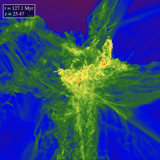
The study, led by the CfA and the University of Portsmouth and published in Astrophysical Journal Letters, builds on earlier predictions of such massive primordial stars forming in turbulent cold-gas streams.
Lead researchers Daniel Whalen and Devesh Nandal describe the finding as solving a 20-year cosmic mystery and confirm observational evidence for monster stars in the cosmic dawn.
In 1,000–10,000 solar-mass stars, helium burning creates carbon, which feeds a hydrogen-burning shell and enables the CNO cycle to produce nitrogen that is then mixed and shed into surrounding gas.
Models of evolution and nucleosynthesis for these ultra-massive stars show this nitrogen production mechanism and subsequent enrichment of the circumnuclear environment.
The work is detailed in The Astrophysical Journal Letters (2025) by Devesh Nandal and colleagues, linking the 1,000–10,000 solar-mass Population III stars to the nitrogen excess in GS 3073 at redshift about 5.55.
Since JWST began operations, the discovery helps address the puzzle of unusually massive black holes in the early universe by identifying their massive stellar progenitors.
The monster stars likely collapse directly into very massive black holes rather than exploding, potentially leaving the actively feeding black hole observed in GS 3073.
These stars may have lived only about a quarter of a million years before collapsing, offering a mechanism for the rapid appearance of massive black holes in young galaxies.
Direct-collapse black holes provide a plausible path to seeding and powering early supermassive black holes observed shortly after the Big Bang.
Summary based on 4 sources
Get a daily email with more Science stories
Sources

Phys.org • Dec 9, 2025
'Monster Stars' from the cosmic dawn: Astronomers find first direct evidence
IFLScience • Dec 10, 2025
Population III: The Never-Seen-Before First Stars In The Universe Might Have Finally Been Spotted