First-Ever Runaway Supermassive Black Hole Confirmed, Leaves 200,000 Light-Year Tail and Supersonic Bow Shock
December 15, 2025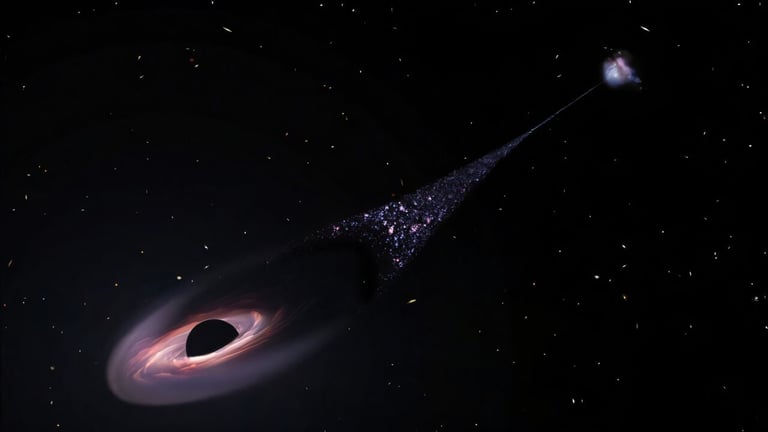

Announced in 2025, the finding confirms decades of theoretical predictions about rogue SMBHs and points to future systematic searches with Euclid and the Roman Space Telescope.
JWST/NIRSpec IFU spectroscopy, alongside HST data, enables simultaneous imaging and spectral analysis to determine motion, composition, temperature, and physical conditions, confirming the bow shock and wake structure.
The competition of data from JWST and HST strengthens the case that the observed features are a wake and bow shock produced by a traveling SMBH, rather than alternative explanations.
The implications include SMBHs escaping their hosts during mergers, gas compression and potential star formation in the wake, and the expectation that more such objects will be found with future observations.
A runaway supermassive black hole is identified by a 62-kiloparsec (about 200,000 light-years) tail and a supersonic bow shock at the head of the wake, with the bow shock and tail serving as crucial evidence.
The ejection mechanisms are three-body interactions during galaxy mergers and gravitational wave recoil from a black hole–black hole merger, both natural outcomes as galaxies merge and their central black holes interact.
The study, led by Pieter van Dokkum of Yale and published under the title JWST Confirmation of a Runaway Supermassive Black Hole via its Supersonic Bow Shock, analyzes the candidate SMBH and its surrounding gas using JWST/NIRSpec IFU observations.
The discovery underscores how SMBHs can traverse and sometimes violently reshape their host galaxies, highlighting ongoing efforts to locate additional fast-moving SMBHs.
In the Cosmic Owl galaxy system, about 8.8 billion light-years away, the first confirmed runaway SMBH (RBH1) is identified by a 62 kpc linear feature and a bow shock at the wake’s head.
The Cosmic Owl consists of two active galactic nuclei forming ring structures, with kinematic data showing velocity gradients that support the bow shock interpretation at the wake tip.
Earlier work suggested the linear feature was a wake behind a runaway SMBH; new JWST and HST data strengthen this interpretation by revealing the bow shock and confirming the wake as the SMBH’s trail.
Summary based on 2 sources
Get a daily email with more Science stories
Sources
Phys.org • Dec 15, 2025
Thank the JWST for confirming the first runaway supermassive black hole