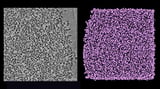
Breakthrough Study Visualizes Chromatin Condensates, Linking Microscopic Structure to Macroscopic Properties
December 4, 2025


Michael Rosen notes this work links molecular structures to mesoscale properties and opens pathways to explore structure–function relationships at intermediate scales.
Interdisciplinary collaboration and the unique MBL environment enabled sustained, immersive work over multiple summers to achieve these insights.
The study advances meso-scale structure–function mapping for chromatin and other condensates and develops a coarse-grained modeling approach linking nucleosome interactions to condensate properties.
The study titled “Multiscale structure of chromatin condensates explains phase separation and material properties” was published in Science on December 4, 2025 (DOI: 10.1126/science.adv6588).
Key collaborators include Huabin Zhou (lead author), Michael Rosen, Rosana Collepardo-Guevara, Elizabeth Villa, Zhiheng Yu, and imaging at Janelia and simulations at MBL.
MBL has long been involved in condensate research, with early observations and pivotal papers establishing foundational mechanisms and the chromatin condensate capacity.
Different chromatin types form condensates with distinct properties, and lab-made condensates resemble the compacted DNA found inside cells, validating the model system.
A major methodological advance combined cryo-electron tomography, computer simulations, and light microscopy at Janelia to visualize nucleosome arrangement inside synthetic and cellular chromatin condensates.
The work provides a blueprint for studying biomolecular condensates beyond chromatin, with implications for gene regulation, stress responses, and potential links to diseases such as neurodegenerative disorders and cancer.
Background: DNA wraps into nucleosomes to form chromatin fibers that stack and condense, with phase separation driving the formation of membrane-less condensates.
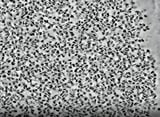
Researchers captured detailed images inside synthetic chromatin condensates, revealing how chromatin fibers and nucleosomes are packaged within droplet-like structures.
A model from MBL and collaborators explains how condensates emerge from individual chromatin components, connecting nanoscale properties to mesoscale condensate behavior.
For the first time, the work ties molecular-scale structures to macroscopic condensate properties, offering a framework to understand meso-scale relationships.
Findings show linker DNA length between nucleosomes influences arrangement and interactions within condensates, affecting phase separation propensity and the material properties of the droplets.
Summary based on 5 sources
Get a daily email with more Science stories
Sources
Phys.org • Dec 4, 2025
Scientists capture first detailed look inside droplet-like structures of compacted DNA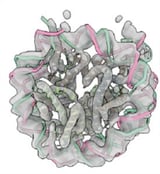
EurekAlert! • Dec 4, 2025
Understanding emerges: MBL scientists visualize the creation of condensates
SciTechDaily • Dec 4, 2025
Microscopic Droplets Reveal DNA’s Secret Architecture