Florida Governor Pushes Controversial Mid-Decade Redistricting Amid Partisan Tensions and Legal Scrutiny
December 4, 2025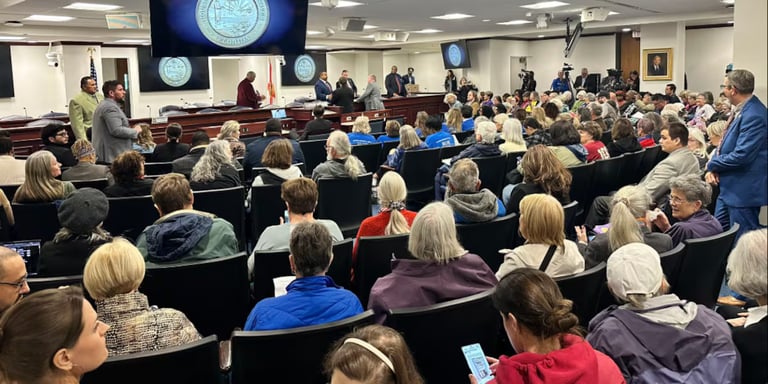

The debate is framed as an arms race of mappower, with states testing fairness ahead of the 2026 midterms.
Nationally, several states are pursuing mid-cycle district changes, positioning Florida as a potential testing ground for partisan redistricting amid broader trends from California to North Carolina.
A notable land transfer valued around $67 million accompanies changes shifting presidential library authority from local governments to the state, drawing scrutiny over transparency and political implications.
Democrats face limited ability to block redistricting amid Republican control, though large-scale protests from pro-democracy groups are planned at the state Capitol.
A revised Florida map could flip multiple Democratic-held districts, though constitutional constraints require maps not to be drawn for partisan gain and mid-decade changes face risks.
Florida’s Amendment 6 from 2010 requires fair districts, positioning courts as final arbiters to ensure compliance with anti-gerrymandering provisions.
Florida Governor is proposing a mid-decade redistricting effort, aiming to start a process this decade with a potential March special session to redraw congressional maps before the 2026 elections, while coordinating with both chambers and weighing Supreme Court rulings on the Voting Rights Act.
Redistricting is governed by the U.S. Constitution, the Voting Rights Act, and state laws; mid-decade redraws are legal but controversial and raise concerns about constitutional safeguards.
The plan faces scrutiny under Florida’s Fair Districts provisions, with opponents arguing it would undermine fair representation.
A separate land-use project linked to the Trump library near Miami has drawn attention, framing broader local political and ceremonial considerations.
Voices from advocacy groups warn of constitutional or discriminatory risks, while supporters argue the process reflects state responsibilities in redistricting.
Opponents, including Democrats and voting-rights advocates, argue the plan tilts the field and could dilute minority influence, naming figures like Rep. Fentrice Driskell and Jonathan Webber as critics.
Mid-decade redraws, while legal, are seen as potentially entrenching partisan advantage and diluting minority representation.
Nationally, midcycle redistricting is projected to yield gains for both parties, with Republicans eyeing roughly nine seats and Democrats about six, though outcomes hinge on ongoing litigation.
The broader race for 2026 could see shifts in control as litigation and court rulings shape how maps are drawn and implemented.
Experts warn that aggressive redistricting could produce a dummymander, making safe Democratic seats more competitive.
Fairness norms in redistricting have weakened, with some states pursuing independent commissions, yet Florida’s judiciary and strong partisan dynamics complicate reforms.
Critics note Florida law bans districts drawn to benefit a party or incumbent, framing the push as potentially at odds with that prohibition.
Possible Democratic targets in Florida include several districts, signaling how map changes could affect incumbents and representation.
The Florida Senate has not yet moved on the plan, with Senate President signaling no active work in his chamber and suggesting the issue be tackled in the spring.
Reporting on the plan comes from NBC News, with contributors including Jane C. Timm and Matt Dixon.
The intra-party conflicts reflect broader constitutional limits on drawing districts to favor or disfavor any party or incumbents.
Historically, DeSantis has supported maps that aided a slim GOP majority while vetoing an earlier map he deemed insufficient.
In 2022, DeSantis vetoed the legislature’s map and redrew a North Florida district to reduce Black representation; the move was challenged but upheld by the Florida Supreme Court and federal judges.
State Rep. Daryl Campbell introduced measures to create independent commissions, seeking to reduce partisan influence in district drawing.
Florida’s 2020 reapportionment added a seat, fueling renewed interest in mid-cycle redistricting and its potential effects on minority districts, though critics warn it could erode trust and stability.
Analysts describe a nationwide trend of mid-decade redistricting as states test maps before 2026, with Republicans signaling potential gains.
Analysts expect Florida to gain three to five Republican seats, though no formal proposals have been filed yet.
Republicans aim to strengthen their Florida House majority amid legal and political hurdles, in a state already with 20 of 28 congressional seats held by Republicans.
Other states have completed mid-decade redistricting, with Texas adding seats and California potentially shifting seats; federal rulings and state actions influence these changes.
Republicans hold a 26-11 edge in the Florida Senate, increasing the odds of map passage, while Democrats decry the move as partisan.
GOP leaders argue redistricting is already underway in other states under Democratic control, forecasting highly partisan maps in both red and blue states.
The article frames redistricting as a high-stakes, legally fraught contest with possible lawsuits and major implications for the 2026 election landscape.
National allies of Trump and a handful of states are revisiting districts, contributing to the broader redistricting debate.
Orlando Democrat Johanna Lopez is cited in discussions, illustrating ongoing Florida legislative debate over redistricting.
Florida faces tension between 2010 Fair Districts Amendments and national trends toward partisan maps, particularly after Texas experiences.
The Florida Supreme Court has weakened the ban on racial gerrymandering but maintains a prohibition on partisan motives; any redraw must justify nonpartisan grounds.
Nationally, midcycle redistricting has become a focal point during Trump’s era, with Texas cases at the Supreme Court and California’s Prop. 50 cited as context.
Civil liberties groups vow to oppose committee actions, arguing partisan redistricting violates fairness and constitutional norms, including Florida’s Fair Districts amendments.
Legislation proposing independent redistricting commissions (HJR 619) aims to depoliticize mapmaking and empower voters to decide fair maps via constitutional changes.
The push is embedded in a broader partisan and legal struggle that could reshape control of the U.S. House in 2026.
Overall, Republicans seek to gain three to five additional Florida House seats, in line with a national wave of midcycle redistricting aimed at shifting balance in Congress.
Florida’s current delegation stands 20 Republicans to eight Democrats, with a sizable registered-party advantage for Republicans.
Senate President Ben Albritton urged senators to shield themselves from partisan influence and noted that all electronic communications about new districts may be retained as records.
Leaders emphasize preserving records and insulating the process from partisan pressures amid past litigation and reform discussions.
Internal GOP friction and a constitutional ban on partisan advantage complicate Florida’s redistricting push, with tension between Gov. DeSantis and legislative leaders.
Summary based on 23 sources
Get a daily email with more World News stories
Sources

CBS News • Dec 4, 2025
Florida redistricting talks begin in growing battle for House control in 2026 elections
Los Angeles Times • Dec 4, 2025
Florida starts redistricting talks in a growing battle for House control in 2026 elections - Los Angeles Times
NBC News • Dec 4, 2025
Florida dives into the redistricting arms race despite political and legal hurdles
ABC News • Dec 4, 2025
Florida starts redistricting talks in a growing battle for House control