NASA's Roman Telescope Set to Revolutionize Cosmic Exploration with Unprecedented Data Accessibility
December 4, 2025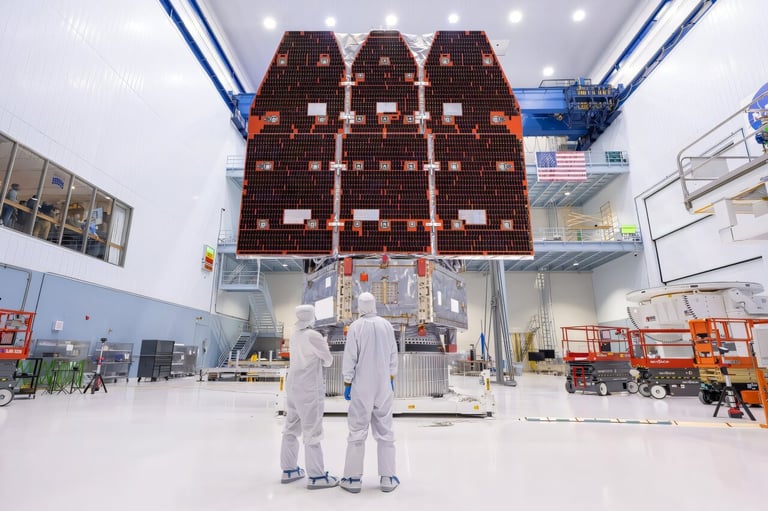

The Wide Field Instrument will capture large sky areas with a 288-megapixel camera, delivering data hundreds of times faster than Hubble and accumulating up to 20 petabytes over the primary five-year mission.
In addition to the core surveys, a Galactic Plane Survey and a General Investigator Program will maximize scientific return, with all data publicly accessible.
In keeping with Dr. Roman’s legacy, the project emphasizes broad accessibility of its data to the global scientific community.
NASA Goddard leads the mission, with involvement from JPL, Caltech/IPAC, and STScI, alongside industrial partners contributing to the project.
The Nancy Grace Roman Space Telescope is designed to study dark energy and dark matter, map hundreds of millions to billions of galaxies, and search for exoplanets, using two primary instruments—the Wide Field Instrument and the Coronagraph Instrument technology demonstrator.
Officials highlighted Roman’s potential for rapid scientific discoveries once it becomes operational, underscoring its role in advancing our understanding of the universe.
Roman aims to identify hundreds of thousands to billions of distant cosmic features, from Earth-like planets to isolated black holes, while shedding light on the universe’s accelerating expansion and honoring Dr. Roman’s pioneering legacy.
Construction of the Nancy Grace Roman Space Telescope is complete, with final assembly and testing underway at NASA Goddard Space Flight Center as of late November.
During its first five years, Roman will conduct three core surveys with the Wide Field Instrument: High-Latitude Wide-Area Survey mapping over a billion galaxies, High-Latitude Time-Domain Survey monitoring changes over years, and Galactic Bulge Time-Domain Survey studying microlensing and exoplanet demographics.
The Coronagraph Instrument will demonstrate new technologies to directly image exoplanets and dusty disks in visible light by blocking starlight.
Its key science goals include probing dark matter and dark energy, mapping vast swaths of the sky, and potentially discovering hundreds of thousands to a hundred thousand transiting exoplanets, along with isolated black holes via microlensing.
The telescope features the Wide Field Instrument, a 288-megapixel camera enabling rapid, wide-field infrared observations, and the Coronagraph Instrument as a technology demonstrator for directly imaging exoplanets and circumstellar disks.
All Roman data will be publicly available with no exclusive-use period, supporting broad community access and an open General Investigator Program.
The mission is named in honor of NASA’s first chief astronomer, Dr. Nancy Grace Roman, and involves coordination among NASA centers—Goddard, JPL, Caltech/IPAC, and STScI—and industry partners BAE Systems, L3Harris, and Teledyne.
Final testing will precede launch preparations at Kennedy Space Center, with an anticipated launch window to fall 2026 through May 2027 atop a SpaceX Falcon Heavy to a distance of about one million miles from Earth.
The Roman observatory is planned to depart Earth on a Falcon Heavy and begin scientific operations roughly one million miles away, marking a major milestone for the mission.
The targeted launch date is by May 2027, with readiness potentially as early as fall 2026.
Summary based on 3 sources
Get a daily email with more Science stories
Sources
NASA • Dec 4, 2025
NASA Completes Nancy Grace Roman Space Telescope Construction - NASA
Phys.org • Dec 4, 2025
NASA completes Nancy Grace Roman Space Telescope construction
NASA Jet Propulsion Laboratory (JPL) • Dec 4, 2025
NASA Completes Nancy Grace Roman Space Telescope Construction