Japanese Physicists Propose Cosmic Knots Theory to Solve Matter Origin Mysteries
December 7, 2025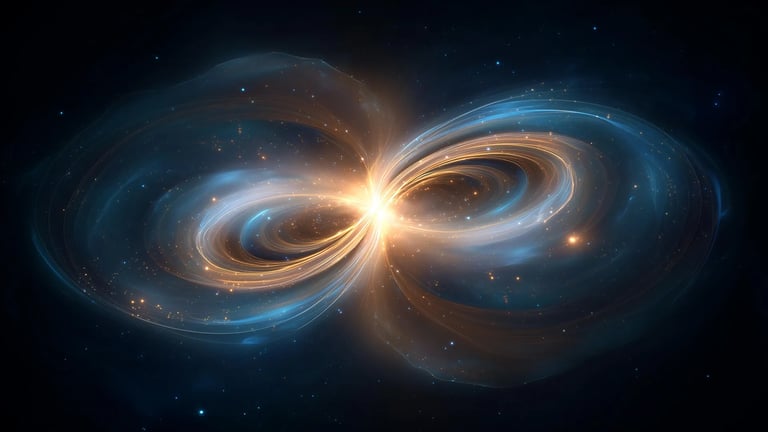

A Japanese team proposes that knotted field configurations, or cosmic knots, naturally arise in a particle physics model that extends the Standard Model with gauged B-L symmetry and Peccei-Quinn (PQ) symmetry, potentially addressing neutrino masses, dark matter, and the strong CP problem.
Intro: Japanese physicists revive Lord Kelvin’s knotted-structure concept to explain the origin of matter, publishing results in Physical Review Letters and linking knotted configurations to neutrino masses, dark matter, and the strong CP problem.
As the universe evolves, the knot-dominated era transitions to radiation domination; knot collapse generates particles and reheats the universe to about 100 GeV, tying the mechanism to the epoch when neutrino-induced asymmetries could create matter over antimatter.
Predicted gravitational-wave signatures arise from knot dynamics, with potential detectability by future observatories such as LISA, Cosmic Explorer, and DECIGO, offering a testable link between knot physics and cosmological history.
Observational prospects: Future gravitational wave observatories like LISA could detect signatures of a knot-dominated era, testing the model through the gravitational wave spectrum.
Cosmic string defects: Early-universe phase transitions could create cosmic strings whose interactions stabilize knot solitons, dominating energy density before decaying via quantum tunneling.
Baryogenesis mechanism: Knot decay produces heavy right-handed neutrinos, driving the matter-antimatter imbalance observed today.
In this model, stable knot solitons form in the early universe and unravel via quantum tunneling, releasing heavy right-handed neutrinos that decay with a slight matter over antimatter preference, thereby producing the observed baryon asymmetry.
Team and scope: Led by Professor Muneto Nitta with Minoru Eto and Yu Hamada, proposing a model where cosmic knots formed in the early universe during phase transitions and influenced baryogenesis.
Conclusion: The work revives Kelvin’s idea with a modern, testable framework, aiming to tighten links between knot dynamics and observable cosmological signals.
The study frames knots as a modernized, testable revival of Kelvin’s knot-as-matter idea, offering a concrete, observable path to explore how the cosmos became matter-rich and how knots could be integral to the origin of matter.
Reheating temperature: The model suggests a reheating temperature around 100 GeV, compatible with generating matter from neutrino imbalances and altering the gravitational-wave background.
The PQ symmetry remains global to preserve axion-related dark matter solutions, while gauging B-L ensures heavy right-handed neutrinos and a mechanism for knot stability through Chern-Simons coupling between PQ vortices and B-L flux tubes.
Theoretical framework: Combines gauged B-L symmetry with Peccei-Quinn symmetry to allow stable knot solitons and relate to the axion as a dark matter candidate and to neutrino mass generation.
Summary based on 2 sources
Get a daily email with more Science stories
Sources
ScienceDaily • Dec 7, 2025
Cosmic knots may finally explain why the Universe exists
SSBCrack News • Dec 7, 2025
Japanese Physicists Explore Cosmic Knots as Key to Matter's Origin in the Universe - SSBCrack News