Record-Breaking Gamma-Ray Burst GRB 250702B Challenges Existing Models, Suggests New Progenitor Scenarios
December 8, 2025

Initial gamma rays were detected by space-based observatories, with X-ray localization and extensive multiwavelength follow-up enabling detailed observations.
Data from Keck, VLT, Hubble, and various X-ray and radio facilities were combined and compared with jet and afterglow models to infer the explosion environment.
The findings are published in The Astrophysical Journal Letters, positioning GRB 250702B as a reference point for interpreting future long-duration, highly obscured bursts.
The study emphasizes multi-wavelength data—gamma-ray, infrared, optical, and X-ray—to understand extreme environments where matter and gravity reach extraordinary extremes.
Publication details and the collaboration’s scope are highlighted, underscoring the international effort behind this work.
Infrared observations with ESO’s VLT confirmed the GRB originated outside the Milky Way, with follow-up tracking of the afterglow using multiple major ground-based telescopes.
The burst took place in a dusty, high-redshift galaxy and featured a jet moving at least 99% of light speed through thick dust, with its long duration enabling simultaneous study of the explosion and its environment.
UNC-Chapel Hill researchers contributed to findings on this record-long GRB, challenging existing models and suggesting a need to consider novel progenitor scenarios.
The event’s record duration suggests it may represent a new or rare class of stellar explosion that defies simple GRB categorization.
Further observations are needed to distinguish among proposed scenarios, with scientists describing the work as cosmic archaeology that reconstructs distant, billions-of-light-year events and shows how much remains to learn about extreme phenomena.
Possible progenitors include massive-star collapse, exotic remnant collisions, or tidal disruption events, but no single cause is confirmed yet.
About half a dozen GRBs with similar long durations exist; GRB 250702B may arise from several novel progenitors, including a black hole consuming a helium- burning star, micro tidal disruption events, or an intermediate-mass black hole disrupting a star.
The gamma-ray burst GRB 250702B appears to have originated from a narrow, ultra-fast relativistic jet plowing through a very dusty, massive host galaxy, with the burst likely occurring in a dense, dust-rich region that may be shielded by a dust lane.
Heavy dust extinction in both the Milky Way and especially the host galaxy made the event largely invisible in optical bands, necessitating near-infrared observations to study the host and afterglow.
The findings are being disseminated across multiple papers and preprints from institutions including LSU, Carnegie Mellon, Rutgers, Radboud, the University of Birmingham, and NASA collaborations, highlighting broad international involvement.
This event underscores the value of coordinated, multi-mission observations for rare, long-duration GRBs and advancing understanding of black hole–star interactions and extreme physics.
Researchers outline several plausible progenitors and position GRB 250702B as a benchmark for comparing future similar bursts to assess whether they fit its properties or hint at new phenomena.
Rapid, prioritized follow-up observations were conducted with the Blanco 4-m, Gemini North and South, and supplemented by Keck I and archival data, spanning roughly 15 hours to 18 days after detection.
An ambitious international collaboration coordinated with ESO’s VLT, NASA’s Hubble, and other facilities to image a fading afterglow in a distant, dust-obscured galaxy.
Led by Jonathan Carney, the team used Blanco and Gemini telescopes along with Keck and archival data from VLT, Hubble, X-ray and radio observatories to monitor the afterglow over an extended period.
GRB 250702B, detected on July 2, 2025, is the longest gamma-ray burst observed, lasting over seven hours with repeated bursts.
The work stresses rapid, coordinated, multi-telescope follow-up as essential to constraining environment and progenitor possibilities for this extraordinary burst.
NASA-led observations across space and ground facilities established the event as a distant, powerful explosion in a dusty, distant galaxy, with precise localization beginning in early July.
Detections by space observatories were complemented by ground-based telescopes such as the VLT, Hubble, and X-ray instruments to focus on a distant, dusty host.
X-ray monitoring detected flares lasting up to two days post-burst, suggesting extended accretion and energy release with no accompanying supernova observed, potentially obscured by dust.
Overall, the event provides insights into extreme physics and the distribution of heavy elements, thanks to the ultra-fast jet and the rich, dusty environment.
The unusually long duration challenges existing GRB models and establishes GRB 250702B as a critical benchmark for future studies.
If confirmed as a black hole swallowing a star, this could be the first evidence of a relativistic jet from an intermediate-mass black hole, signaling a potential new class of GRB progenitors.
Hubble and Webb observations helped characterize the host galaxy as exceptionally massive, more than twice the Milky Way’s mass, and placed the event about eight billion years in the past.
Summary based on 5 sources
Get a daily email with more Science stories
Sources
NASA Science • Dec 8, 2025
Black Hole Eats Star: NASA Missions Discover Record-Setting Blast - NASA Science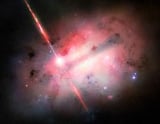
EurekAlert! • Dec 8, 2025
Gemini and Blanco telescopes unlock clues to origin of longest gamma-ray burst ever observed