NASA's Europa Clipper Embarks on Mars Flyby for Critical Instrument Tests and Trajectory Boost
February 25, 2025

Managed by the Jet Propulsion Laboratory (JPL) in Pasadena, California, the Europa Clipper project involves collaboration with multiple NASA centers and organizations.
This close encounter will occur at 12:57 p.m. EST, with Europa Clipper traveling at a speed of 15.2 miles per second relative to the sun.
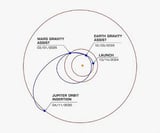
Launched on October 14, 2024, from Kennedy Space Center, NASA's Europa Clipper is on a 1.8 billion-mile mission to explore Jupiter's moon Europa.
On March 1, 2025, the spacecraft will execute a gravity assist flyby of Mars, coming within 550 miles of the planet.
The mission's primary objectives include examining the thickness of Europa's icy shell, its composition, and geological characteristics, contributing to our understanding of potential habitable worlds beyond Earth.
NASA's mission planning incorporates gravity assists, similar to past missions like Voyager 1 and 2, which successfully leveraged planetary alignments to gain momentum.
The spacecraft weighs 12,750 pounds and would require additional propellant without the gravity assists, which would increase mission costs and duration.
This flyby serves as a precursor to a second gravity assist from Earth planned for December 2026, which will provide a velocity boost for the spacecraft.
NASA engineers have planned multiple trajectory correction maneuvers to ensure the spacecraft's path remains accurate, with three already completed prior to the Mars flyby.
During the flyby, scientists will conduct tests on Europa Clipper's radar instrument and thermal imager, crucial for its scientific objectives.
The flyby will not only adjust the spacecraft's trajectory but also allow for the calibration of its thermal imager and the first full test of its radar system.
JPL engineers meticulously calculate trajectories to maximize energy efficiency, likening the process to a game of billiards among planets.
Summary based on 3 sources
Get a daily email with more Science stories
Sources
NASA • Feb 25, 2025
NASA’s Europa Clipper Uses Mars to Go the Distance - NASA
Phys.org • Feb 25, 2025
NASA's Europa Clipper uses Mars to go the distance