AI Market to Surge by $237.4 Billion by 2028 Amidst Ethical and Workforce Challenges
February 3, 2025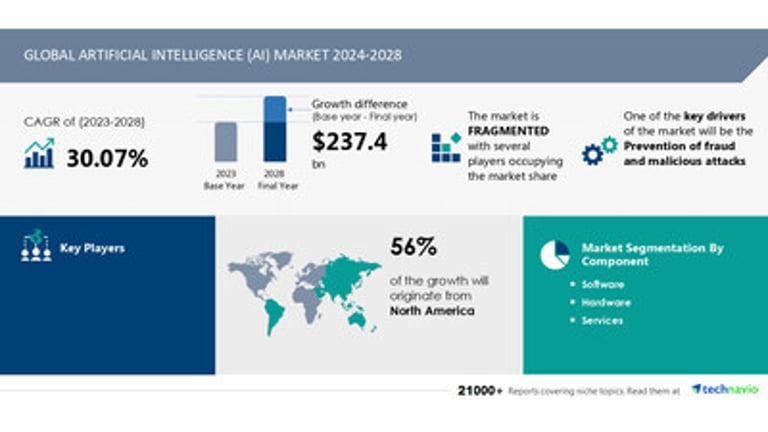

This market is characterized by fragmentation, featuring major players such as Advanced Micro Devices, Google LLC, IBM Watson Health, Microsoft, and NVIDIA Corporation.
Market segmentation in the report is detailed by components such as software, hardware, and services, as well as end-users like retail and healthcare, geography, and technology.
To address these challenges, AI marketplaces and customizable AI solutions are emerging, facilitating easier access for businesses looking to integrate AI into their operations.
Emerging trends in AI include the integration of deep learning and data analytics into next-generation technologies such as generative AI and edge AI.
Regionally, North America leads the AI market, contributing 56% of the total market share, followed by Europe and Asia-Pacific.
AI is being widely adopted across various industries, including healthcare, banking, e-commerce, and IT, for purposes such as enhancing customer experience, fraud prevention, and workflow management.
Key drivers for this market growth include the increasing need for fraud prevention and the rising trend of cloud-based AI services.
However, the market faces significant challenges, including a shortage of skilled AI professionals, ethical concerns, privacy issues, and algorithmic bias.
The global artificial intelligence (AI) market is on a robust growth trajectory, projected to expand by USD 237.4 billion from 2024 to 2028, with a compound annual growth rate (CAGR) of 30.07%.
Continuous growth in the AI sector is driven by advancements in deep learning, data analytics, and machine learning technologies.
Overall, while the AI market is rapidly evolving and expanding, it must navigate the complexities of workforce shortages and ethical considerations to sustain its growth.
The report providing this analysis covers a historical period from 2018 to 2022, with 2023 serving as the base year for the current evaluation.
Summary based on 3 sources
Get a daily email with more AI stories
Sources
Curated - BLOX Digital Content Exchange • Feb 3, 2025
Artificial Intelligence (AI) Market to Grow by USD 237.4 Billion from 2024-2028, Driven by Fraud Prevention and Malicious Attack Mitigation, Report on AI's Market Transformation - Technavio