Embryonic Heart Cells 'Speed Date' to Form Tissues, New Study Finds
March 12, 2025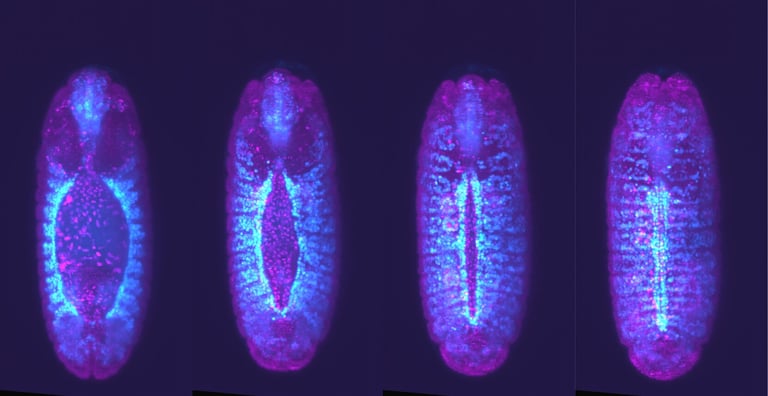

Previous research has shown that these protein-induced waves enhance the chances of mismatched cells finding suitable partners.
If cells mismatch during this pairing process, proteins create waves that separate them, providing another opportunity to find compatible partners.
The research, led by Timothy Saunders from the University of Warwick, emphasizes that as cells come together, they consistently adjust and pair with similar heart cells.
Saunders likened this pairing process to speed dating, where cells have limited time to assess compatibility before being pulled apart by molecular forces.
The team tested their model on fruit fly hearts with specific mutations, accurately predicting how cells would rearrange under conditions of misalignment.
The broader implications of this research extend beyond heart development, as similar cell-matching processes are crucial in neuronal connections, wound healing, and facial development.
This research received funding from multiple sources, including the University of Warwick and various research grants.
The findings aim to quantify biological processes, enhancing our understanding of cellular behaviors during tissue formation.
A recent study published in the Biophysical Journal reveals that heart cells in developing embryos engage in a process akin to 'speed dating' to find suitable neighbors for tissue formation.
These developing heart cells utilize tentacle-like protrusions known as filopodia to explore and attach to potential partners.
In both humans and fruit flies, heart tissues originate from two distant regions of the embryo that must converge to form a functional heart.
The study discovered that heart cells seek stability by balancing adhesive energy and elasticity, which facilitates their self-organization during development.
Summary based on 3 sources
Get a daily email with more Science stories
Sources

ScienceDaily • Mar 12, 2025
Cells 'speed date' to find their neighbors when forming tissues
Phys.org • Mar 12, 2025
Cells 'speed date' to find their neighbors when forming tissues
SciTechDaily • Mar 12, 2025
Inside the Microscopic Tug-of-War That Builds a Beating Heart