Twisting Atom-Thin Materials Unleashes New Quantum Computing Potential
March 17, 2025

Researchers at the University of Rochester have made a groundbreaking discovery that twisting two atom-thin materials at high angles unlocks unique optical properties, potentially advancing quantum computing technologies.
Nickolas Vamivakas, a professor of Optical Physics, explained that twisting these materials enables optical control of artificial atoms while protecting them from environmental interference.
Focusing on molybdenum diselenide, a complex two-dimensional material, the team twisted it at angles up to 40 degrees, leading to the formation of excitons that retain information when activated by light.
The study, published in Nano Letters, demonstrates that layering nano-thin materials creates excitons, which function as qubits for quantum information.
The team believes that exploring other materials with higher information-retaining capacities at large angles could yield even better results.
This research was supported by the Air Force Office of Scientific Research and conducted at URnano facilities.
This work builds on the 2010 Nobel Prize-winning discovery of graphene, which exhibits special quantum characteristics when layered and twisted.
Previous studies have focused on small angle twists of materials to create moiré superlattices, which exhibit properties like superconductivity.
Ph.D. candidate Arnab Barman Ray highlighted the surprising retention capability of molybdenum diselenide compared to other moiré materials, suggesting that exploring different materials could yield even better performance.
The researchers view their findings as a significant step towards developing new quantum devices, with potential applications in quantum networks and advanced lasers.
Summary based on 4 sources
Get a daily email with more Science stories
Sources

ScienceDaily • Mar 17, 2025
Twisting atomically thin materials could advance quantum computers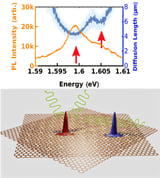
Phys.org • Mar 17, 2025
Twisting 2D materials creates artificial atoms that could advance quantum computers
Mirage News • Mar 17, 2025
Twisting Thin Materials May Boost Quantum Computing
Technology Networks • Mar 18, 2025
Twisting Atom-Thin Materials Could Advance Quantum Computers