Gaia Space Telescope Retires After 12 Years of Milky Way Mapping, Leaving Lasting Legacy
March 26, 2025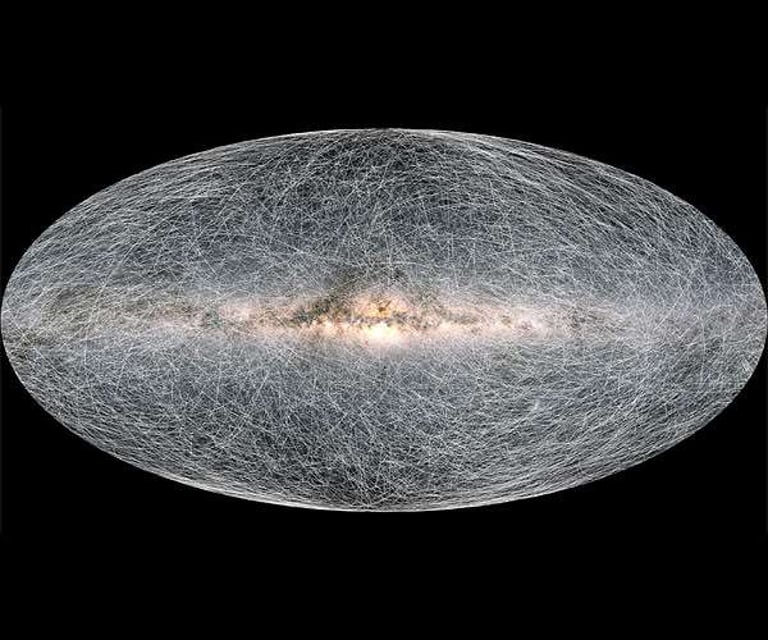


Originally planned for a five-year mission, Gaia exceeded expectations by operating for twelve years, leading to groundbreaking discoveries, including unexpected findings related to black holes.
The legacy of Gaia will continue as scientists analyze its extensive data, with a fourth star catalog expected in 2026 and a final catalog anticipated around 2030.
Despite its significant achievements, Gaia remains relatively unknown to the general public compared to other high-profile space missions.
ESA's mission operations director expressed a mix of pride and sadness over the mission's conclusion, highlighting its lasting impact on the field.
Research utilizing Gaia's data has revealed ancient star streams and provided evidence of the Milky Way's history of consuming smaller dwarf galaxies.
Following its final communication, Gaia will continue to orbit the Sun alongside Earth, having been carefully decommissioned to prevent disruption to other spacecraft.
The Gaia space telescope was officially powered down and transitioned into a 'retirement orbit' around the Sun on March 27, 2025, marking the end of its decade-long mission to map the Milky Way.
Over its operational period, Gaia recorded more than three billion measurements, significantly enhancing our understanding of the Milky Way's structure, composition, and evolution.
Initially stationed 1.5 million kilometers from Earth at the second Lagrange point, Gaia was later moved to avoid interference with newer telescopes like James Webb and Euclid.
Despite the vast amount of data collected, less than a third has been released to the scientific community, indicating that much remains to be explored.
Gaia's contributions have fundamentally transformed the field of astronomy, providing insights into galactic evolution and supporting new missions, including those focused on exoplanets.
Launched on December 19, 2013, Gaia executed a critical maneuver in 2014 to reach its stable orbit, where it could effectively conduct its observations.
Summary based on 15 sources
Get a daily email with more World News stories
Sources

The New York Times • Mar 27, 2025
Gaia to Shut Down After More Than a Decade of Mapping the Milky Way
Yahoo News • Mar 27, 2025
Star-mapping space telescope Gaia sent into 'retirement orbit'
Digital Trends • Mar 27, 2025
Saying farewell to Gaia, as the Milky Way-mapping space telescope mission ends
Phys.org • Mar 27, 2025
Star-mapping space telescope Gaia sent into 'retirement orbit'