Penn State Doctoral Student Awarded $60K Fellowship for Innovative Brain Injury Imaging Research
March 31, 2025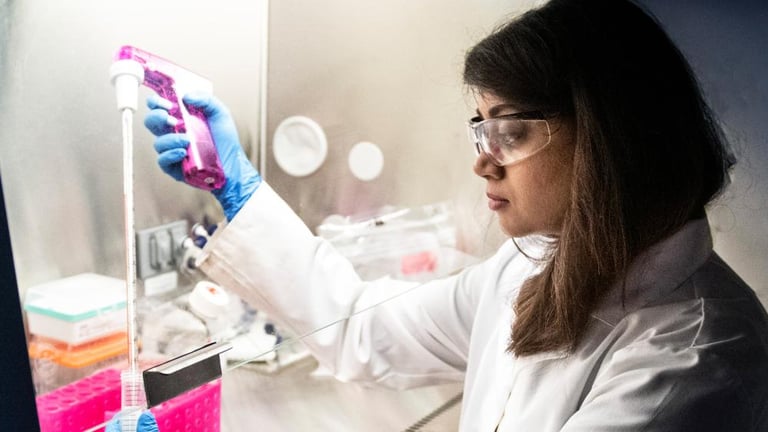

Gunaseelan holds a bachelor's degree in electronics and communication engineering from the Birla Institute of Technology and Science in India, and a master's degree in biomedical engineering from the University of Illinois Urbana-Champaign, along with previous experience as a research engineer and fellow.
Her current research is further supported by a grant from the U.S. Department of Defense through the Congressional Directed Medical Research Program.
Nivetha Gunaseelan, a doctoral candidate in biomedical engineering at Penn State University, has been awarded a prestigious predoctoral fellowship from the American Heart Association (AHA), valued at over $60,000, to support her research on molecular imaging of brain injuries.
This technique aims to provide high-resolution, colored images that differentiate between soft tissue, fat tissue, and bone, which could lead to quicker medical responses.
Her research is crucial as brain injuries significantly contribute to cerebrovascular diseases and are leading causes of injury-related deaths and disabilities; thus, early and accurate detection is vital.
Under the guidance of her adviser, Dipanjan Pan, a professor in nanomedicine and nuclear engineering, Gunaseelan's work focuses on improving the detection and staging of brain injuries.
Gunaseelan expressed that receiving the AHA fellowship validates the significance of her research and enhances her capacity to advance diagnostic imaging.
The AHA Predoctoral Fellowship aims to support promising graduate students in their research and clinical training to enhance global cardiovascular and brain health, providing two years of financial support including a stipend, health insurance, and travel support.
She has developed an innovative imaging technique known as spectral photon-counting CT, which utilizes nanoparticles to identify biomarkers released in the brain after injuries, enhancing visualization of brain injuries.
Gunaseelan's recent contributions include co-authoring a paper published in 'Advanced Science' that discusses the application of spectral photon-counting CT in biomedical settings.
Additionally, she was the first author of a paper published in December 2024, which applied spectral photon-counting CT to biomedical applications.
Looking ahead, Gunaseelan plans to explore the use of photon-counting CT for image-guided drug delivery, which could significantly impact treatment for chronic illnesses like cancer and heart disease.
Summary based on 2 sources
Get a daily email with more Science stories
Sources
Penn State University • Mar 31, 2025
Biomedical engineering grad student earn American Heart Association fellowship | Penn State University
Penn State University • Mar 31, 2025
Biomedical engineering grad student earns American Heart Association fellowship | Penn State University