Stentor Study Reveals Single-Celled Organisms' Cooperative Behavior Resembling Human Survival Strategies
April 1, 2025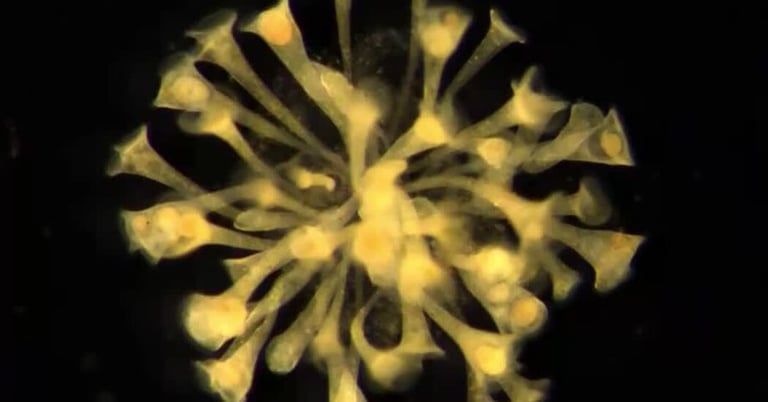

Mathematical modeling reveals that Stentors frequently change neighbors to optimize feeding flows, showcasing a form of 'promiscuity' that boosts their collective food intake.
Interestingly, weaker Stentors gain more from collaboration than their stronger counterparts, oscillating between partners in a behavior reminiscent of the phrase 'she loves me, she loves me not'.
This research emphasizes a phase in evolution where single cells formed temporary colonies for mutual benefit without committing to permanent multicellularity.
The findings underscore the importance of physical conditions and predator-prey interactions in the evolutionary journey toward multicellular life on Earth.
Researchers suggest that physical forces, rather than solely chemical interactions, may have significantly influenced the evolution of multicellular organisms.
Despite their cooperative tendencies, Stentor colonies are temporary and can disperse easily, raising questions about the evolutionary advantages of such transient associations.
A recent study published in Nature Physics examines Stentor, a unicellular organism that can grow up to 2 mm long and demonstrates cooperative feeding behavior.
When food is plentiful, Stentors prefer to remain in colonies, but they switch to individual foraging when resources are scarce, indicating a survival strategy akin to that of humans.
These dynamic colonies enhance feeding efficiency by generating stronger water vortexes when they are in proximity, which leads to improved prey capture.
The study illustrates how these single-celled organisms can create a higher flow of water around them, facilitating the intake of bacteria and algae.
The study also highlights that current Stentor colonies consist of genetically distinct individuals, making them a valuable model for understanding the evolution of multicellularity.
Lead author Shashank Shekhar, a biophysicist at Emory University, points out that the cooperative behavior of Stentors challenges the notion that complex behaviors are exclusive to multicellular organisms.
Summary based on 2 sources
Get a daily email with more Science stories
Sources
The New York Times • Mar 31, 2025
Eating ‘Family Style’ May Have Set the Stage for Life as We Know It