Disintegrating Exoplanet with Massive Mineral Tail Discovered 140 Light-Years Away
April 23, 2025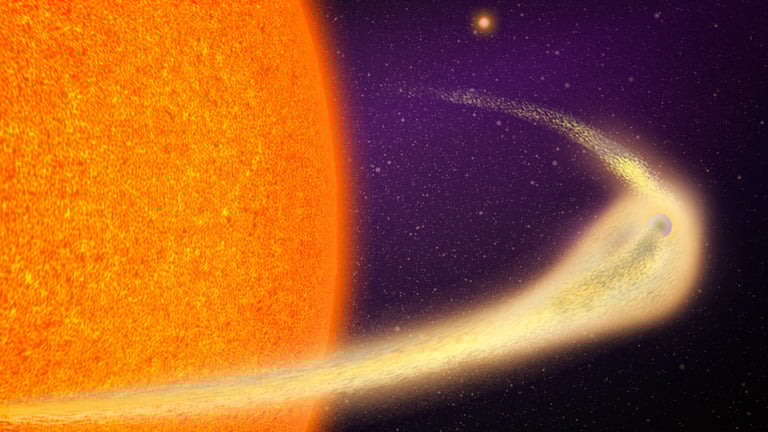

Astronomers have made a groundbreaking discovery of a disintegrating exoplanet named BD+05 4868 Ab, which features a comet-like tail shedding material during its orbit.
The intense heat causes minerals on the planet's surface to vaporize, leading to a molten surface and the formation of a massive debris tail.
The extreme conditions lead to the evaporation of minerals into space, creating gas, dust, and debris that contribute to the planet's tail.
This planet, comparable in size to Mercury, orbits its star every 30.5 hours, resulting in extreme surface temperatures estimated at around 3,000 degrees Fahrenheit.
The dust in the tail is notably large, comparable to sand grains, providing insights into the processes behind the planet's disintegration.
Avi Shporer, a research scientist at MIT, noted that the planet's small size prevents it from retaining evaporating material due to the extreme heat from its star.
Detected by NASA's TESS mission, BD+05 4868 Ab exhibits a tail of minerals extending up to 9 million kilometers, offering a unique opportunity to study a planet in its final stages of existence.
Observations indicate that the unusual transit signal suggests the tail is composed of mineral grains rather than gases, which would typically be found in comets.
Simulations have shown that radiation pressure influences the distribution of dust grains in the tail, resulting in varying sizes and lengths of debris trails.
A smaller leading tail in front of the planet may provide further insights into the dynamics of dust tails and the theories of their formation.
This discovery is particularly significant as only three other planets with tails have been identified, making BD+05 4868 Ab's tail notable for its length and brightness.
The findings were published in The Astrophysical Journal Letters by a team led by Marc Hon from MIT's Kavli Institute for Astrophysics and Space Research.
Summary based on 9 sources
Get a daily email with more Science stories
Sources

Mashable • Apr 23, 2025
This weird planet sports a giant tail like a comet
Newsweek • Apr 23, 2025
Astronomers Discover Planet With a Tail
ScienceAlert • Apr 23, 2025
This Melting Planet Laid a Trail of Destruction Over 5 Million Miles Long
ExtremeTech • Apr 23, 2025
MIT Catches a Planet Disintegrating As It Zips Around Its Star