Sodium Dehydroacetate Ban: Health Risks Prompt 2025 Food Safety Action
April 23, 2025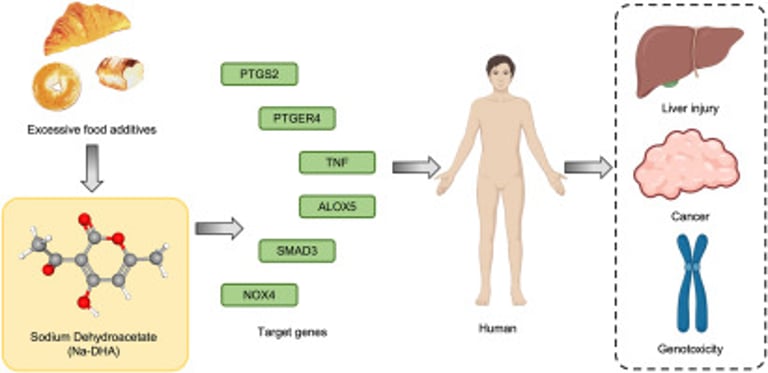

Sodium dehydroacetate (Na-DHA) is a commonly used food preservative known for its ability to inhibit microbial growth; however, recent studies have raised significant concerns about its potential health risks, including cancer, liver injury, and genotoxicity.
Predictions from ADMETlab 3.0 indicate that Na-DHA poses risks for genotoxicity, hepatotoxicity, and carcinogenicity, with inflammation and oxidative stress identified as central mechanisms contributing to its toxicity.
Prior research has linked Na-DHA to various adverse health effects such as weight loss, allergic dermatitis, and cardiovascular risks, which underscores the necessity for thorough safety evaluations.
The multi-organ toxicity profile of Na-DHA challenges traditional safety assessments, highlighting the need for comprehensive evaluations of food additives to better understand their risks.
Network analyses have identified six core targets related to Na-DHA-induced cancer and liver injury, as well as four core targets associated with genotoxicity, indicating that its toxicity may impact multiple organs through shared pathways.
This research utilizes network toxicology to assess the toxicological effects of Na-DHA, pinpointing key molecular targets such as ALOX5, PTGER4, PTGS2, and SMAD3, which are linked to inflammation and oxidative stress.
Gene Ontology and KEGG pathway enrichment analyses reveal that Na-DHA activates harmful pathways, including the AGE-RAGE signaling pathway, which is associated with tissue damage and cancer development.
Given these findings, the importance of experimental validation of Na-DHA's effects is emphasized to refine regulatory thresholds and ensure food safety.
As a result of safety concerns, the usage of Na-DHA in various food products will be banned starting February 8, 2025, following several incidents of contamination and health risks.
Summary based on 1 source