JWST Captures Distant Galaxies, Redefines Our Understanding of Cosmic Evolution
May 1, 2025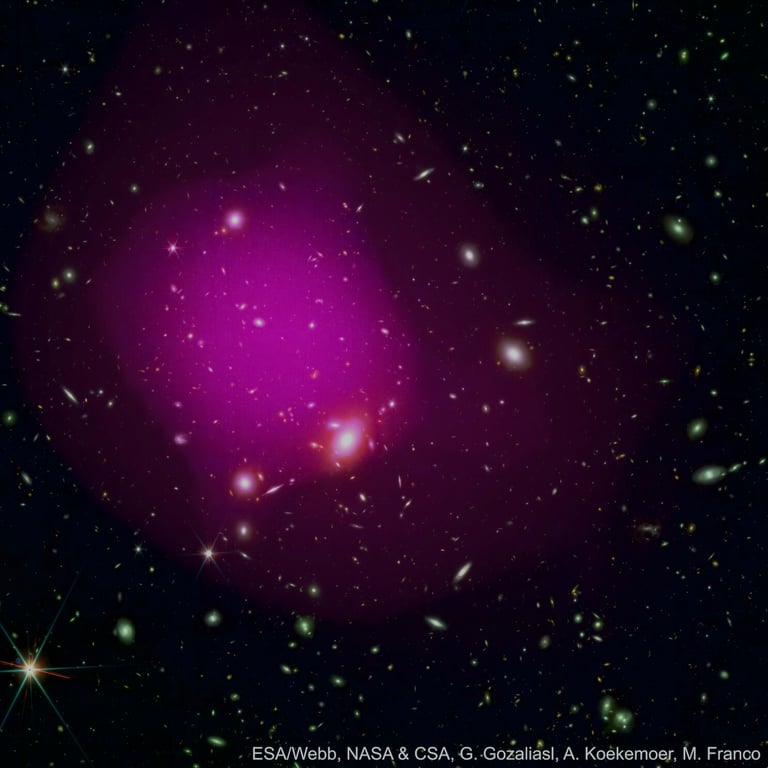

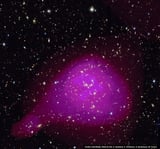
The James Webb Space Telescope (JWST), operational since 2022, has captured an impressive image showcasing thousands of distant galaxies, particularly highlighting a galactic group that existed around 7 billion years ago.
The catalog enables comparisons between ancient and more recent galaxy structures, revealing evolutionary patterns in galaxy groups and their brightest galaxies.
Observations indicate a transformation from irregular, actively star-forming early galaxies to more organized elliptical or spiral structures in more recent galaxies.
As researchers analyze this extensive data, significant revisions to current theories of galaxy formation and evolution are anticipated.
Ghassem Gozaliasl from Aalto University, who led the detection team, noted that this sample allows for the study of galaxy evolution over 12 billion years.
This survey captures cosmic evolution within the universe's first 12 billion years, providing crucial insights into galaxy formation and structure.
Galaxies cluster in dense regions connected by filaments, forming a structure known as the cosmic web, with most galaxies residing in groups or larger clusters.
The COSMOS-Web survey integrates data from various telescopes, including JWST and the Hubble Space Telescope, to gather comprehensive insights by observing different wavelengths of light.
This ability to observe objects at such great distances allows scientists to look back in time and study the early universe's structure and evolution.
A team of international astronomers has cataloged nearly 1,700 galaxy groups in the COSMOS-Web region, marking a significant achievement in extragalactic astronomy.
Galaxy groups and clusters are environments filled with dark matter, hot gas, and supermassive black holes, playing a vital role in galaxy evolution.
Despite expectations that intergalactic gas should cool over time, it remains hot and exhibits behavior such as 'sloshing' due to gravitational forces from colliding galaxies.
Summary based on 4 sources
Get a daily email with more Science stories
Sources
Digital Trends • Apr 30, 2025
James Webb captures another stunning image of thousands of distant galaxies
Universe Today • Apr 30, 2025
JWST Completes a Huge Survey of the Earliest Galaxies