Friedrich Merz as Chancellor: Germany's Strategic Shift in EU and Balkan Policies
May 17, 2025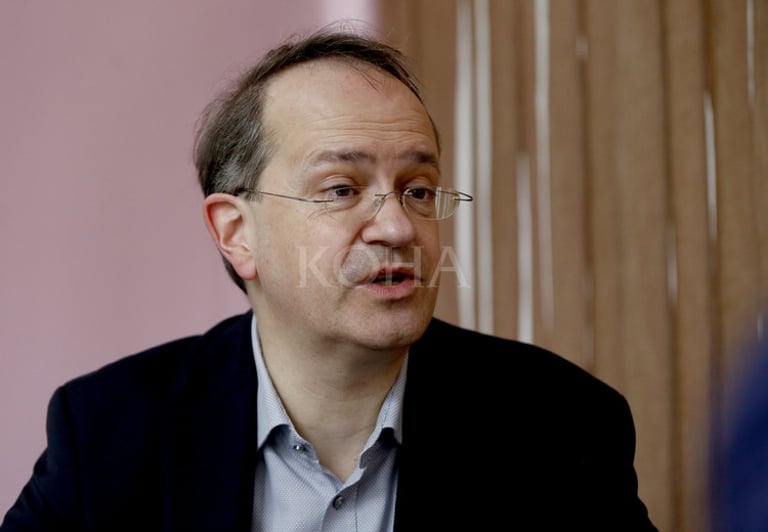

He also discusses the conditionality of Kosovo's membership, particularly concerning the establishment of the Association of Serb-majority Municipalities.
Merz's early actions, including visits to Paris, Warsaw, and Kiev, indicate Germany's intention to assert a leading role in EU and global policy, particularly in light of perceived US disengagement.
Bodo Weber, a senior fellow at the Council for Democratization Policies, argues that the EU has lacked a cohesive strategic policy for the Balkans for over two decades and urges Germany to develop one, especially regarding the crisis in Bosnia.
Weber warns that if the new government fails to shift its strategy regarding Serbia, the political dialogue may further deteriorate, which would undermine the EU's credibility in the region.
He calls for Germany to take a leading role in EU policy for the Western Balkans and to revive meaningful dialogue with Serbia under President Aleksandar Vučić.
Regarding Kosovo's membership in the Council of Europe, Weber indicates that Germany's leniency compared to France may continue, depending on the establishment of a strategic framework.
Friedrich Merz was sworn in as Germany's Chancellor on May 6, 2025, marking a significant moment as he becomes the tenth person to hold this position in the country's history.
Despite the normalization agreement between Kosovo and Serbia accepted in 2023, there has been little practical implementation, which has been a point of contention.
He anticipates that bilateral relations between Germany and Kosovo will remain stable, focusing on maintaining development assistance despite the shifting political landscape.
Weber concludes that Germany must take a decisive stance against malign influences from external actors like Russia and China in the Balkans, which requires strong leadership to achieve a cohesive EU policy.
Weber emphasizes the need for Germany's new government to adopt a strategic approach towards the Kosovo-Serbia dialogue, advocating for a 'strategic turn' in its dealings with Vučić's regime.
Weber criticizes the previous Franco-German proposal for Kosovo-Serbia dialogue, stating it led to the collapse of political discussions and resulted in agreements that were not followed through.
Summary based on 2 sources
Get a daily email with more EU News stories
Sources

Telegrafi • May 17, 2025
Weber: The new German government must make a strategic turn in the Kosovo-Serbia dialogue
KOHA.net • May 17, 2025
Weber: New German government must make strategic turn in Kosovo-Serbia dialogue