New Metal-Free Catalyst Revolutionizes PET Recycling, Achieves 99% Efficiency with Ionic Liquids
May 19, 2025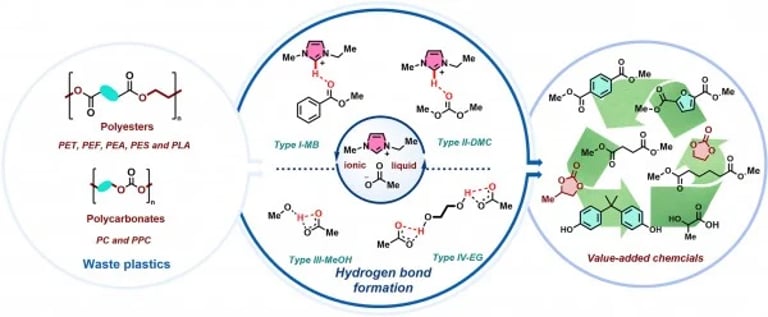

The versatility of this new method allows it to be applied to various polyesters and polycarbonates, thereby extending its potential impact beyond just PET.
This innovative method utilizes ionic liquids, particularly [EMIm][OAc], to catalyze the methanolysis of PET, achieving complete conversion into DMT and EC within just 2.5 hours.
Unlike traditional recycling methods that often rely on metal catalysts, this approach eliminates metal contamination, making it a cleaner and more sustainable solution.
Traditional mechanical recycling methods degrade material quality, and while chemical recycling via methanolysis has potential, challenges like incomplete depolymerization and reliance on metal catalysts have limited its effectiveness.
Researchers from Zhejiang University have developed a groundbreaking metal-free catalytic method to upcycle polyethylene terephthalate (PET) waste into valuable chemicals, specifically dimethyl terephthalate (DMT) and ethylene carbonate (EC).
The method's effectiveness stems from the formation of hydrogen bonds between the ionic liquid and reactants, which activates the carbonyl and hydroxyl groups necessary for the depolymerization of PET.
Overall, the method supports the transition towards a circular economy by effectively transforming plastic waste into valuable raw materials.
The process showcases impressive yields, with 99% for DMT and 91% for EC, all under mild conditions, significantly enhancing the efficiency of PET recycling.
This development could significantly reduce the environmental impact of PET waste, a major contributor to global pollution, and positions the method as a promising solution for industrial-scale recycling.
Lead researcher Dr. Qingqing Mei emphasizes the method's transformative potential in addressing the plastic waste dilemma and contributing to a circular economy.
The research, published in the journal Eco-Environment & Health, was supported by multiple funding sources, including the National Natural Science Foundation of China and the Key Research and Development Program of Zhejiang Province.
This innovative approach not only enhances the efficiency of PET recycling but also represents a significant advancement in sustainable recycling practices.
Summary based on 2 sources
Get a daily email with more Science stories
Sources
EurekAlert! • May 19, 2025
Innovative metal-free method upcycles PET waste into valuable chemicals
Newswise • May 19, 2025
Innovative Metal-Free Method Upcycles PET Waste Into Valuable Chemicals | Newswise