Melting Sea Ice Alters Underwater Light, Threatens Marine Life and Climate Stability
May 4, 2025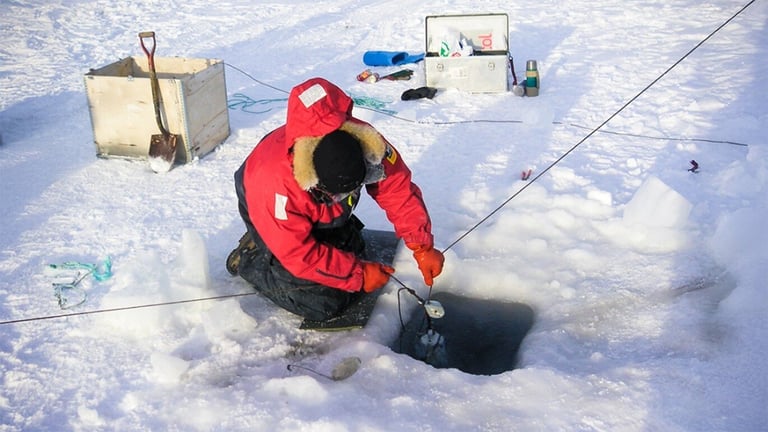

A recent study published in Nature Communications reveals that global warming-induced sea ice loss in polar regions is significantly altering underwater light conditions, which could harm marine life.
Led by marine biologists Monika Soja-Woźniak and Jef Huisman from the University of Amsterdam, the research team included experts from the Netherlands and Denmark who examined how sea ice loss impacts light spectra in the ocean.
As sea ice melts, the underwater light shifts from a diverse spectrum to a blue-dominated spectrum, negatively affecting the photosynthetic efficiency of algae that thrive under a wider range of light colors.
Computer simulations demonstrated that the main light wavelength shifts from around 550 nanometers (green light) under ice to 472 nanometers (blue light) in open water, limiting the colors available for marine organisms.
The research indicates that algal species specialized for blue light may outcompete ice algae, potentially altering the species composition and productivity of these organisms.
Lead author Monika Soja-Woźniak emphasized that algae adapted to the diverse light spectrum under ice may struggle to survive in this new blue-dominated environment.
Some algae, such as Arctic diatoms, traditionally thrive under diverse light conditions but may be disadvantaged in a blue-dominated environment, while species like Micromonas that favor blue light may benefit.
Professor Jef Huisman noted that changes in algae productivity or composition could reduce the ocean's capacity to absorb CO₂, exacerbating climate change and impacting the Arctic food web.
The findings call for improved climate models and ocean forecasts to account for changes in light spectra and photosynthesis in polar regions, highlighting the broader ecological implications of climate change.
Researchers found that as ice melts, sunlight becomes more limited and primarily blue, affecting microscopic organisms essential to the food chain.
Adaptation to the new light conditions may not be feasible for many species, as rapid ice melting outpaces the evolutionary ability of organisms to adjust their pigments.
Under sea ice, sunlight passes through in a full spectrum of colors, while open water absorbs much of the red and green light, leading to the characteristic blue color of oceans.
Summary based on 2 sources
Get a daily email with more Science stories
Sources

Phys.org • May 2, 2025
Loss of sea ice alters the colors of light in the ocean
Times of India • May 4, 2025
Study reveals how melting ice changes ocean light, affecting arctic food chain