NASA Unveils Massive JWST Data, Revealing Unprecedented Cosmic Views with COSMOS-Web
June 10, 2025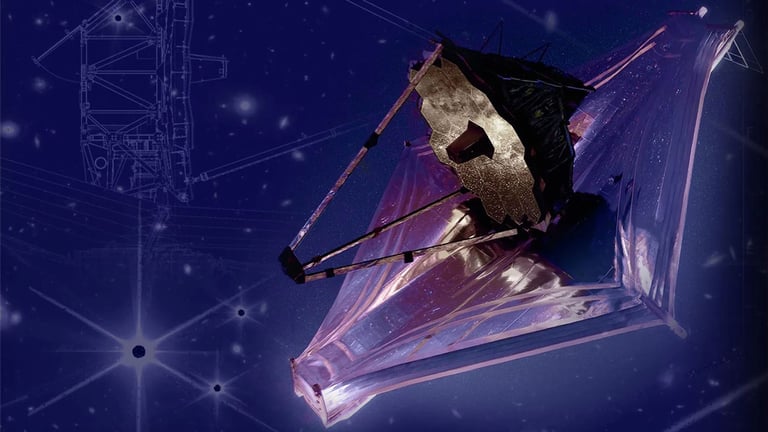

The project has utilized the CANDIDE supercomputer in France to compile images into a comprehensive mosaic, contributing to the extensive dataset now available.
NASA has released over 1.5 TB of data from the James Webb Space Telescope (JWST) as part of the Cosmic Evolution Survey (COSMOS), providing an unprecedented view of the universe.
To assist users, COSMOS-Web offers a full photometric catalog detailing photometry, structural measurements, redshifts, and physical parameters for the observed galaxies.
COSMOS-Web is one of approximately 100 projects utilizing the $10 billion JWST to observe high redshift galaxies across a large cosmic area, contrasting with other surveys that focus on smaller regions for deeper observations.
The dataset provides the largest deep view of the universe available to date, featuring nearly 800,000 galaxies with complete NIRCam and MIRI mosaics.
The JWST NIRCam mosaics are organized into 20 zones, with images available in four filters: F115W, F150W, F277W, and F444W.
This dataset includes a galaxy catalog and an interactive viewer that allows users to search for specific images and view their properties, covering an area of 0.54 square degrees of sky with the Near Infrared Camera (NIRCam) and 0.2 square degrees with the Mid Infrared Instrument (MIRI).
The COSMOS-Web program is a NASA-supported initiative involving collaboration between the University of California, Santa Barbara, and the Rochester Institute of Technology.
Artifacts in images can include non-astrophysical elements, such as 'snowball' ghost images from bright stars, which can affect observations made by the JWST.
The project aims to study galaxies formed shortly after the Big Bang, during a critical transition when the universe moved from a neutral hydrogen state to ionized gas.
While raw data from JWST was already public, the COSMOS-Web project enhances usability by calibrating and correcting imaging artifacts, making the data cleaner for scientific analysis.
A key goal of the COSMOS project is to understand the structure of galaxies in relation to the reionization process, which occurred about 200 million years after the Big Bang.
Summary based on 3 sources
Get a daily email with more Science stories
Sources
The Register • Jun 9, 2025
1.5 TB of James Webb Space Telescope data just hit the internet

Slashdot • Jun 10, 2025
1.5 TB of James Webb Space Telescope Data Just Hit the Internet - Slashdot