ESA Unveils First Images of Sun's South Pole, Unlocking Solar Mysteries
June 12, 2025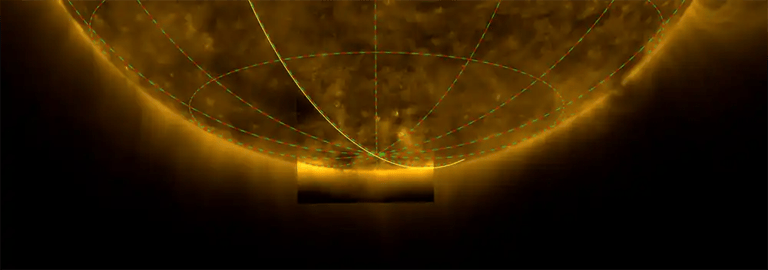

The European Space Agency (ESA) has achieved a significant milestone by releasing the first-ever images of the Sun's South Pole, captured by the Solar Orbiter spacecraft.
These groundbreaking images were obtained using three advanced instruments aboard the Solar Orbiter: the Polarimetric and Helioseismic Imager (PHI), the Extreme Ultraviolet Imager (EUI), and the Spectral Imaging of the Coronal Environment (SPICE).
Captured in mid-March 2025, the Solar Orbiter was positioned at angles of 15 and 17 degrees below the solar equator, allowing for unprecedented views of the Sun's polar regions.
Initial findings from these images reveal a chaotic magnetic field at the Sun's South Pole, exhibiting both northern and southern magnetic fields, indicative of the solar maximum phase.
Direct observation of the Sun's magnetic fields is crucial for understanding their evolution and interactions, which can enhance predictions of solar storms that affect Earth.
Understanding the dynamics of the Sun's magnetic field is essential, as it influences an approximately 11-year cycle of solar activity, including solar flares and coronal mass ejections (CMEs).
While most of the released images focus on the Sun's South Pole, some also include views of the North Pole, an area that has remained largely unexplored until now.
The full dataset from the Solar Orbiter's first polar mission is expected to arrive on Earth by October 2025, promising further insights into solar science.
ESA Science Director Carole Mundell emphasized that these images mark the beginning of a new era in solar research, highlighting the Sun's dual role as a life-giving star and a potential disruptor of modern technology.
The Solar Orbiter, launched in 2020, is set to continue its mission, with plans to increase its observational angle to over 33 degrees by 2029, allowing for even more comprehensive studies of solar activity.
New solar missions, including the Solar Orbiter, are providing unprecedented views of the Sun, revealing insights into long-standing scientific puzzles and enhancing our understanding of solar dynamics.
Despite advancements in solar observation, predicting the timing and intensity of solar maximum events remains challenging, which is vital for ensuring the safety of communications and astronauts on Earth.
Summary based on 6 sources
Get a daily email with more Science stories
Sources
CNET • Jun 12, 2025
See the Sun in a Way You've Never Seen It Before, From Above and Below
DEV Community • Jun 12, 2025
First Ever Images of the Sun’s Poles Open a New Frontier in Space Science (20250612-130651)
Smithsonian Magazine • Jun 12, 2025
See the First-Ever Direct Images of the Sun's South Pole, Captured by the Solar Orbiter Spacecraft
Sky & Telescope • Jun 12, 2025
Never-Before-Seen Views of the Sun