NASA's Roman Telescope Set to Unveil Dark Matter Mysteries with 160,000 Gravitational Lenses
June 12, 2025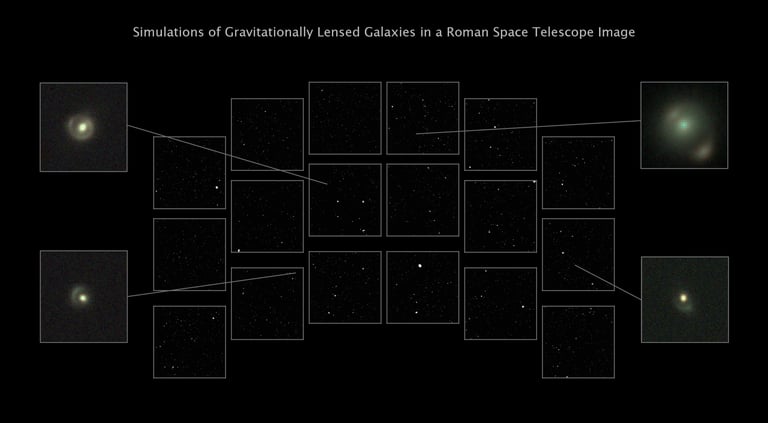

Gravitational lensing, a phenomenon predicted by Einstein, occurs when a foreground galaxy magnifies distant galaxies behind it, creating distorted images.
The Roman Space Telescope's camera, the Wide Field Instrument, will measure light bending with extreme precision, allowing researchers to detect smaller dark matter structures that contribute to galaxy formation.
Roman's 300-megapixel camera will enable high-resolution observations, which could improve understanding of dark matter substructure through studies on strong lensing.
A research team led by Bryce Wedig estimates that Roman will identify over 160,000 gravitational lenses, significantly surpassing the hundreds cataloged by the Hubble Space Telescope.
NASA's Nancy Grace Roman Space Telescope is set to begin operations in 2027, aiming to enhance our understanding of dark matter through gravitational lensing.
Dark matter, which constitutes a significant fraction of a galaxy's mass, influences gravitational lensing effects but has never been directly detected since it does not emit, absorb, or reflect light.
With operations set to begin in 2027, gravitational lensing will become more common, enabling expansive surveys of the cosmos.
The telescope is managed by NASA's Goddard Space Flight Center, with contributions from various institutions and industrial partners across the United States.
The telescope will conduct three core surveys, including the High-Latitude Wide-Area Survey, to systematically explore cosmic lenses.
The research team plans to combine Roman's infrared images with data from ESA's Euclid mission and the Vera C. Rubin Observatory for comprehensive studies of gravitational lenses.
The research team aims to validate the Lambda Cold Dark Matter cosmological model at sub-galactic scales using data from the Roman Telescope.
The ultimate goal of this research is to identify the particles that constitute dark matter, as current understanding of its nature remains limited despite some known properties.
Summary based on 4 sources
Get a daily email with more Science stories
Sources
Phys.org • Jun 12, 2025
NASA's Roman to peer into cosmic 'lenses' to better define dark matter
Newswise • Jun 12, 2025
NASA’s Roman to Peer Into Cosmic ‘Lenses’ to Better Define Dark Matter | Newswise
Yale News • Jun 12, 2025
Study: Roman Telescope may be transformative in better defining dark matter