Revolutionary Vera C. Rubin Observatory Unveils Universe's Secrets with 3,200-Megapixel Camera
June 17, 2025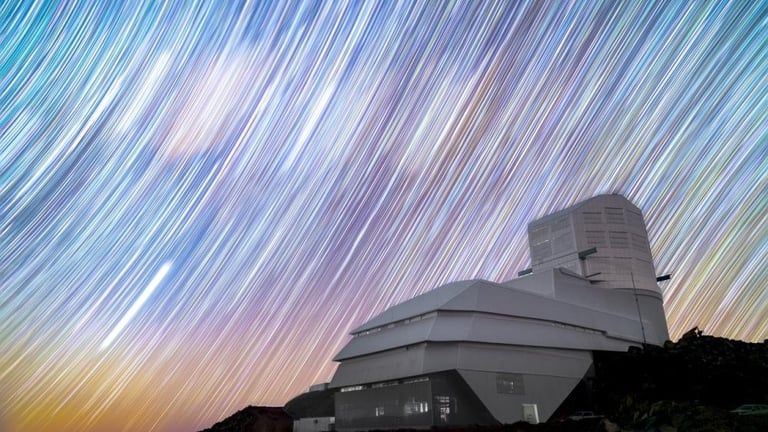

Equipped with the largest digital camera ever constructed, featuring a 3,200-megapixel capacity, the observatory will capture high-definition images of the universe every three to four nights.
Rubin Deputy Project Scientist Federica Bianco noted that the observatory will generate data equivalent to filling 10 million books each night, creating a comprehensive record of the night sky.
The LSST's wide field of view will enable it to detect real-time changes in the sky and observe rare celestial events, such as supernovae and gamma-ray bursts.
Over its operational period, the observatory is expected to produce about 60 petabytes of data, which will aid in various astronomical inquiries including the study of dark matter and dark energy.
The data collected will facilitate research into a range of astronomical phenomena, including Earth-crossing asteroids and the structure of the Milky Way.
The LSST aims to provide the most detailed time-lapse view of the cosmos, allowing scientists to observe 10 million moving objects and other significant astronomical events.
The observatory will unveil its first images and videos during a live-streamed event on June 23, 2025, marking a significant milestone in astronomical research.
Live watch parties will be held globally, inviting both astronomers and the public to participate in this groundbreaking moment in astronomy.
These watch parties will take place at various planetariums, universities, and museums worldwide, featuring immersive full-dome images of the Southern Hemisphere night sky.
The University of Delaware is hosting a public watch party for the event, starting at 10 a.m., with registration available online.
Bianco emphasized the potential of artificial intelligence to analyze the vast data collected, suggesting it could unveil new cosmic mysteries.
The Vera C. Rubin Observatory, located on Cerro Pachón in Chile, is set to embark on the Legacy Survey of Space and Time (LSST), funded by the U.S. National Science Foundation and the Department of Energy.
Summary based on 5 sources
Get a daily email with more Science stories
Sources

Scientific American • Jun 16, 2025
See Vera C. Rubin Observatory’s First Images Live with These Watch Parties
ScienceAlert • Jun 17, 2025
A Game-Changing Telescope Is About to Drop First Pics. Here's How to Watch.
University of Delaware • Jun 17, 2025
Join the UD watch party for Rubin Observatory's big reveal, June 23 | UDaily
Penn State University • Jun 17, 2025
Tune in to unveiling of first images from the Vera C. Rubin Observatory and LSST | Penn State University