Study Reveals Ancient Humans' Adaptability Key to Global Migration Success 50,000 Years Ago
June 19, 2025


A new study published in Nature reveals that ancient Homo sapiens developed the ability to adapt to various extreme habitats, which facilitated their migration from Africa around 50,000 years ago.
All non-Africans are descended from a small group of people who migrated into Eurasia approximately 50,000 years ago, following several failed dispersals prior to this event.
The findings indicate that the ecological flexibility of modern humans was crucial for their successful global dispersal, allowing them to thrive in new and often challenging environments.
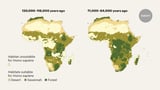
Researchers analyzed archaeological evidence from sites dating back to between 120,000 and 14,000 years ago, noting a significant increase in the range of habitats occupied by humans around 70,000 years ago.
This period saw humans transitioning from primarily living in savannas and forests to occupying challenging environments such as dense rainforests and arid deserts, showcasing their remarkable ecological flexibility.
The study suggests that increased cultural exchange and contact among human groups may have contributed to this ecological flexibility, enabling them to overcome geographic barriers.
The findings challenge earlier theories that attributed successful migrations to specific technological advancements or improved information-sharing methods, focusing instead on ecological flexibility.
Key researchers, including Emily Hallett and Eleanor Scerri, highlight that this adaptability was not due to a single evolutionary change but resulted from a complex interplay of factors such as wider geographical distribution and cultural exchanges.
Eleanor Scerri emphasizes that humans' adaptability as 'ecosystem generalists' is a key factor in their survival across diverse environments.
Unlike previous failed migrations, the successful dispersal into Eurasia coincided with less favorable climatic conditions, suggesting that groups migrating after 60,000 years ago had enhanced adaptability due to their experiences in diverse environments.
William Banks from the University of Bordeaux notes that while Homo sapiens exhibited this adaptability, other early human ancestors also migrated and established settlements, raising questions about why only Homo sapiens survived long-term.
The research provides insight into why Homo sapiens were prepared for migration, yet it does not explain why they alone survived among other early human species.
Summary based on 6 sources
Get a daily email with more World News stories
Sources
Nature • Jun 18, 2025
Homo sapiens adapted to diverse habitats before successfully populating Eurasia

PBS News • Jun 18, 2025
Adapting to extreme habitats set the stage for global human migration, study finds
Live Science • Jun 18, 2025
'Huge surprise' reveals how some humans left Africa 50,000 years ago