Astronomers Uncover Massive Hot Gas Filament, Solving Universe's Missing Matter Mystery
June 19, 2025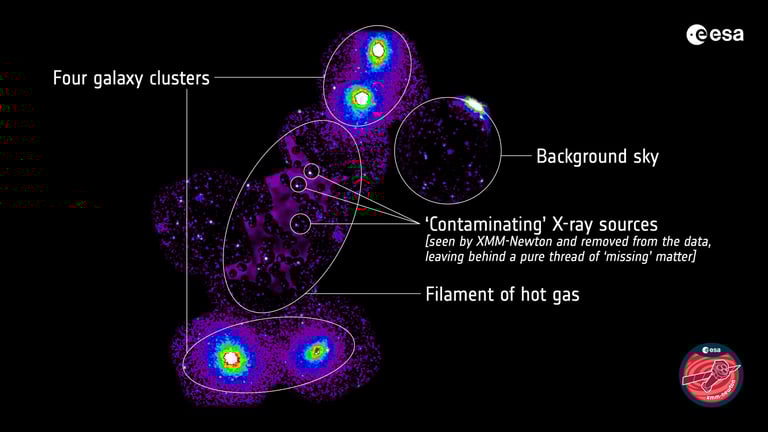

Astronomers have made a groundbreaking discovery of a massive filament of hot gas that bridges four galaxy clusters, with a mass ten times greater than that of the Milky Way, potentially solving the long-standing mystery of missing matter in the Universe.
This newly identified filament, which measures over 10 million degrees Celsius, stretches diagonally for 23 million light-years through the Shapley Supercluster, home to over 8,000 galaxies.
The findings were published on June 19 in the journal Astronomy & Astrophysics, marking a significant advancement in understanding the connections between galaxy clusters and the distribution of matter in the universe.
Lead researcher Konstantinos Migkas emphasized that this discovery aligns with simulations of cosmic structures, reinforcing previous astrophysical theories about the 'cosmic web' that supports the universe's structure.
For decades, models of the universe have suggested that a third of baryonic matter is missing, and this discovery confirms that those models were accurate.
Baryonic matter, which includes protons and neutrons, constitutes only about 15-16% of the universe, with a significant portion still unaccounted for, leading to the hypothesis that it exists in long filaments of gas.
This filament, composed of ordinary matter known as baryons, includes the atoms that make up stars, planets, and living organisms.
Norbert Schartel, a project scientist for XMM-Newton, noted that the discovery strengthens the standard cosmological model and confirms long-standing simulations.
The research utilized the European Space Agency's XMM-Newton and JAXA's Suzaku X-ray telescopes to accurately characterize the filament's properties by isolating its light from nearby cosmic sources.
Future observations of similar filaments may be challenging, but there are plans for new X-ray satellites designed specifically for this purpose.
The ongoing ESA Euclid mission, launched in 2023, aims to further explore the cosmic web and investigate the nature of dark matter and energy, which together constitute 95% of the universe.
The particle density within the filament is about ten particles per cubic meter, which is 30 to 40 times higher than the average density found in the universe.
Summary based on 7 sources
Get a daily email with more Science stories
Sources
ScienceDaily • Jun 19, 2025
Massive thread of hot gas found linking galaxies — and it’s 10 times the mass of the Milky Way
“The models were right”: astronomers find ‘missing’ matter
“The models were right”: astronomers find ‘missing’ matter
Phys.org • Jun 19, 2025
'The models were right': Astronomers find 'missing' matter linking four galaxy clusters
The Register • Jun 19, 2025
ESA's XMM-Newton finds huge filament of missing matter