Study Reveals Toddlers Outpace AI in Language Learning by 92,000 Years
June 24, 2025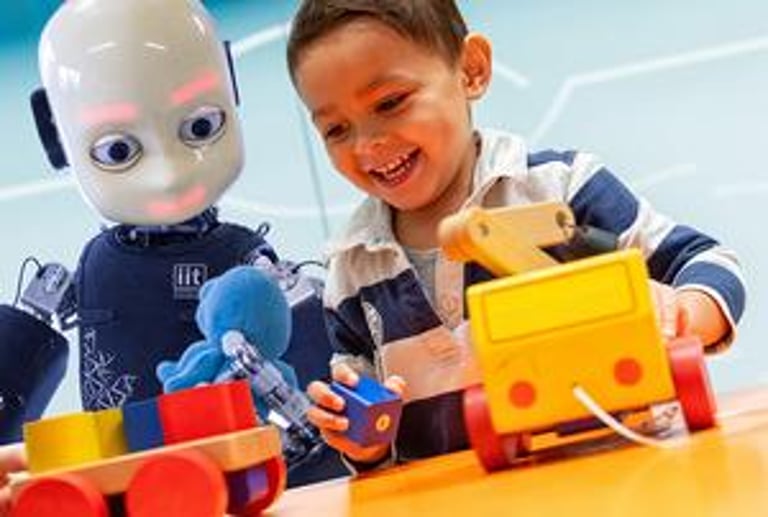


A recent study published in Trends in Cognitive Sciences reveals that children learn language significantly faster and more effectively than AI systems like ChatGPT, which would take an astonishing 92,000 years to achieve fluency at the same pace as a toddler.
Unlike AI, which processes static data, children dynamically adapt their learning through real-time engagement with their surroundings and caregivers.
Led by Professor Caroline Rowland at the Max Planck Institute for Psycholinguistics, the study introduces a new framework that outlines how children's embodied learning processes contribute to their language acquisition.
The research identifies four critical components essential for children's language mastery: structure-building mechanisms, multimodal input integration, active adaptive learning, and dynamic developmental change.
Despite advancements in data collection, theoretical models explaining children's language learning have not kept pace, prompting the development of this innovative framework.
This research challenges the traditional cognitive-centric view of language acquisition, framing it as an embodied process that integrates physical exploration, social interaction, and sensory experience.
Children exhibit 'prediction-based learning,' which allows them to anticipate sentence structures and quickly refine their language skills through error correction.
The framework emphasizes that children's language learning involves integrating sensory experiences—sight, sound, movement, and touch—enabling them to build language skills in a rich, interactive environment.
The findings suggest that insights from child language acquisition could inform the design of more effective AI systems and enhance our understanding of adult language processing and human language evolution.
The research underscores that the quality of learning is more important than the quantity of data processed, highlighting that toddlers remain the benchmark for efficient language learning.
Current AI language models require exposure to billions of words to perform at an adult level, while children achieve complex grammatical understanding with significantly less input.
The study suggests a need for AI systems to emulate the active learning processes observed in children, focusing on how they learn from their experiences rather than merely the amount of information received.
Summary based on 4 sources
Get a daily email with more AI stories
Sources

Phys.org • Jun 24, 2025
Brains over bots: Why toddlers still beat AI at learning language
EurekAlert! • Jun 24, 2025
Brains over bots: why toddlers still beat AI at learning language
Neuroscience News • Jun 24, 2025
Why Children Learn Language Faster Than AI
ScienceBlog.com • Jun 24, 2025
Toddlers Crush ChatGPT: The Secret Behind Children’s Lightning-Fast Language Learning