Newly Discovered Exoplanet Triggers Massive Flares in Host Star, Defying Prior Beliefs
July 2, 2025

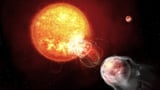
The study reveals that HIP 67522 b's rapid orbit disrupts the star's magnetic field, resulting in energetic flares that significantly impact the planet's atmosphere.
These flares are described as thousands of times more energetic than solar flares and occur approximately once every one to two Earth days.
This discovery marks the first direct observation of a planet inducing flares in its star, challenging the previous belief that stellar activity was a one-way interaction.
The phenomenon has been termed a 'planet with a death wish', as the energetic flares are around 100 times more powerful than previously anticipated.
Ekaterina Ilin, the first author of the study, noted that the planet triggers these flares at specific moments, with the energy of the resultant eruptions exceeding that of the initial waves.
The findings suggest that HIP 67522 b could experience significant atmospheric erosion, potentially shrinking in size over the next 100 million years to become as small as Neptune.
The research team emphasizes the need for further studies across different wavelengths to understand the energy dynamics involved and to investigate other similar star-planet systems.
Future research aims to determine how common this phenomenon is and whether it can serve as a detection method for other self-destructive planets.
Published in Nature on July 2, 2025, this study sets the stage for further exploration into the unique characteristics of HIP 67522 b and similar star-planet interactions.
Astronomers have made a groundbreaking discovery using the European Space Agency's Cheops mission, identifying an exoplanet named HIP 67522 b that appears to be causing radiation flares from its host star, HIP 67522.
HIP 67522 is a young star, approximately 17 million years old, and its magnetic field is notably active, leading to frequent flaring events.
The planet, comparable in size to Jupiter, orbits its star at a remarkably close distance, completing a full orbit in just seven days, which intensifies the gravitational interactions between the two bodies.
Summary based on 8 sources
Get a daily email with more Science stories
Sources
Mashable • Jul 2, 2025
A Jupiter-size planet as delicate as cotton candy provokes its star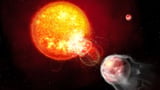
Gizmodo • Jul 2, 2025
‘Death Wish’ Planet Actively Triggers Destructive Flares From Its Host Star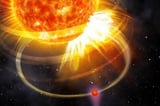
Scientific American • Jul 2, 2025
Astronomers Found the Most Self-Destructive Planet in the Sky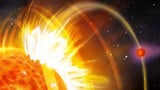
Live Science • Jul 2, 2025
'A completely new phenomenon': Astronomers spot a planet causing its star to constantly explode