Discovery of Human Neural Compass Offers Insight into Navigation and Alzheimer's Detection
August 18, 2025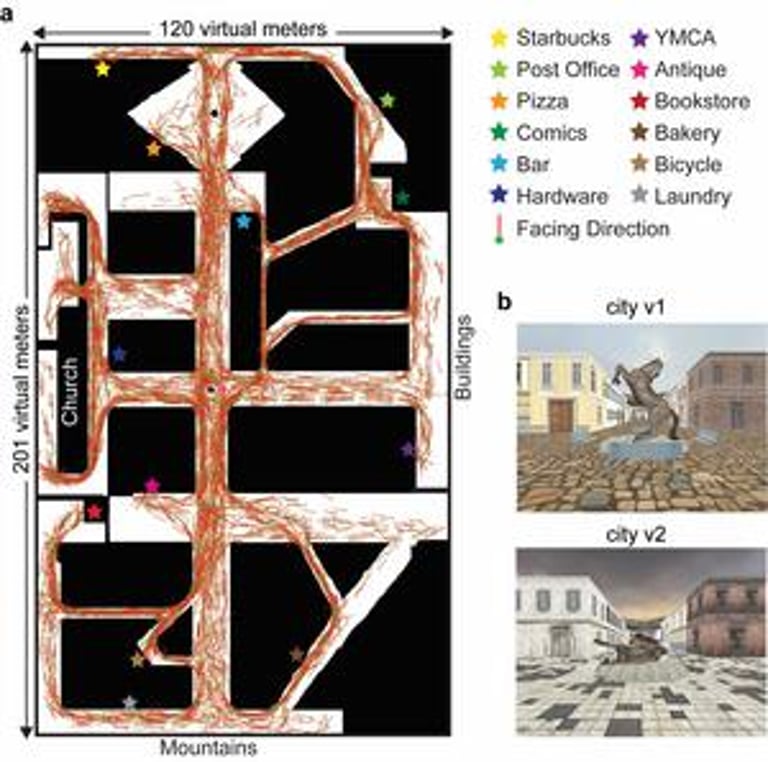

The research advocates for interdisciplinary collaborations across neuroscience, psychology, virtual technology, and clinical fields to deepen our understanding of human navigation and cognition.
These findings imply that the identified brain regions are critical for spatial orientation and could serve as biomarkers for neurodegenerative diseases that impair the sense of direction.
The discovery highlights how the brain maintains a coherent sense of direction despite changing environments, and these regions also encode broader directional relationships, aiding navigation even with limited or no visual cues.
By employing immersive virtual reality combined with advanced encoding models, the study addressed previous limitations and observed brain activity during active, realistic navigation, paving the way for future research.
Researchers from the University of Pennsylvania used neuroimaging data from 15 participants to identify two brain regions that encode a person's forward-facing direction during navigation in virtual cities, with neural signals consistent across different visual environments and task phases.
These regions represent a broad range of facing directions relative to the north–south axis, functioning as a neural compass that helps maintain orientation.
This discovery provides evidence for a human neural compass similar to head direction cells found in rodents, with implications for understanding navigation deficits in neurodegenerative diseases like Alzheimer's.
The study, published in the Journal of Neuroscience in 2025, highlights the importance of understanding how visual and internal cues are integrated for navigation, which could inform early detection and monitoring of diseases involving spatial disorientation.
The research aims to deepen understanding of navigation using both visual and internal cues, which is especially relevant for individuals with impaired vision or neurodegenerative conditions, as highlighted by Dr. Epstein.
This work is particularly significant for developing strategies and technologies to assist those with cognitive or sensory impairments in improving their navigation skills and maintaining cognitive health.
The study underscores the utility of virtual reality as a scientific tool for studying cognition and navigation, demonstrating its potential beyond entertainment for applications in neuroscience, education, rehabilitation, and cognitive training.
Limitations of the study include a small sample size and reliance on virtual environments, suggesting future research could explore augmented reality or real-world navigation to extend these findings.
Understanding how environmental interactions influence neural mechanisms is crucial for maintaining cognitive health amid urbanization and technological distractions.
Summary based on 5 sources
Get a daily email with more Science stories
Sources

EurekAlert! • Aug 18, 2025
Identifying a compass in the human brain
Medical Xpress • Aug 18, 2025
Identifying a compass in the human brain
Neuroscience News • Aug 18, 2025
Brain’s Inner Compass Reveals How We Navigate Cityscapes
ScienceBlog.com • Aug 18, 2025
Scientists Discover the Brain’s Hidden Compass for Finding Our Way