Chinese Scientists Revolutionize Genome Editing with New Programmable Chromosome Engineering System
August 4, 2025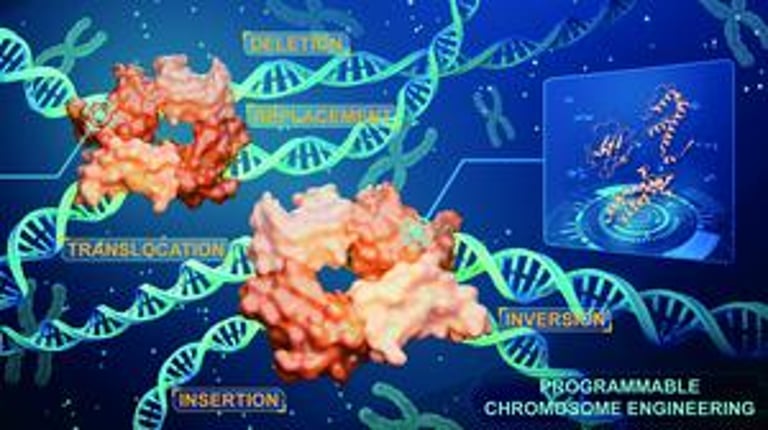

The researchers also created a high-throughput platform for rapid recombination site modification and proposed asymmetric Lox site designs, which significantly reduce reversible recombination activity.
Overall, this research represents a significant advancement in genome engineering, opening new avenues for precise modifications across various organisms.
A team of Chinese researchers led by Prof. Gao Caixia has made a groundbreaking advancement in genome editing with the development of new technologies known as Programmable Chromosome Engineering (PCE) systems, as detailed in a study published in Cell on August 4, 2025.
As a proof of concept, the researchers successfully created herbicide-resistant rice germplasm through a precise inversion of 315 kb, showcasing the technology's potential for genetic engineering and crop improvement.
This research addresses and overcomes the historical limitations of the traditional Cre-Lox system, which has been hindered by reversible recombination reactions and complications in engineering Cre recombinase.
The PCE systems enable precise DNA manipulations ranging from kilobase to megabase scales, significantly enhancing chromosomal manipulation capabilities in higher organisms, particularly in plants.
Key achievements of the PCE technology include the targeted integration of DNA fragments up to 18.8 kb, complete replacement of 5-kb sequences, and chromosomal inversions and deletions.
In addition, the team developed AiCErec, a recombinase engineering method that optimizes Cre's multimerization interface, achieving a recombination efficiency 3.5 times greater than that of the wild-type Cre.
To further enhance precision, they introduced a scarless editing strategy using Re-pegRNA, which allows for the seamless replacement of residual Lox sites with original genomic sequences.
The study highlights the advancements made in overcoming the limitations of the site-specific recombinase Cre-Lox system, which has previously restricted broader applications in genetic engineering.
Summary based on 3 sources
Get a daily email with more Science stories
Sources

Phys.org • Aug 4, 2025
Megabase-scale precision genome editing achieved in eukaryotic cells
EurekAlert! • Aug 4, 2025
Scientists achieve megabase-scale precision genome editing in eukaryotic cells
News-Medical • Aug 4, 2025
Programmable Chromosome Engineering systems enable precise DNA manipulations