Revolutionary Ultrasound Technique Activates Brain Circuits Without Damage, Paving Way for Safer Neurological Treatments
August 5, 2025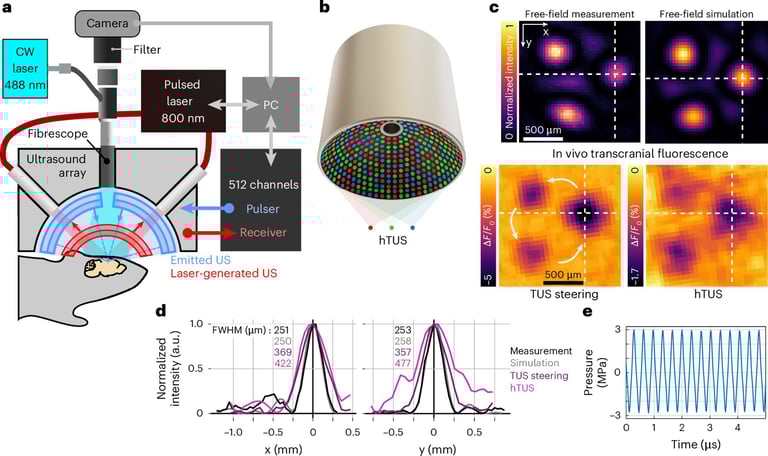

A groundbreaking study from NYU Langone Health and the University of Zurich has demonstrated that ultrasound waves can activate brain circuits in living animals through holographic patterns.
Researchers utilized a helmet of 512 ultrasound emitters to create holograms that focused sound waves onto specific brain regions, enabling precise monitoring of neuron activation through fluorescence signals.
The findings, published in Nature Biomedical Engineering, reveal that it is feasible to activate entire neural networks in a living mouse brain by targeting circuits distributed across different brain regions.
Co-senior author Shy Shoham emphasized that this transcranial ultrasound stimulation (TUS) technique can enhance the sensitivity of targeted neurons to ultrasound by up to ten times, improving treatment efficiency and safety.
Unlike current FDA-approved treatments that destroy neurons to alleviate conditions like Parkinson's disease, this innovative method temporarily activates neurons without causing damage.
Achieving effective ultrasound therapy requires precise targeting of brain areas and careful calibration of wave strength to avoid damaging brain tissue.
Future research aims to explore more complex neural circuits and the potential for deeper brain activation using ultrasound, with some applications already being tested clinically.
The study was published on July 7, 2025, with funding from the National Institutes of Health and the Swiss National Science Foundation, and involved a diverse team of researchers.
Funding for the study was provided by the National Institutes of Health and the Swiss National Science Foundation, with contributions from various researchers including postdoctoral fellow Théo Lemaire.
This research introduces a system that combines ultrasound sources and a fiber scope to visualize brain activation in study mice, potentially advancing treatments for neurological diseases and mental health disorders.
Co-senior authors Shy Shoham and Daniel Razansky noted that the TUS technique could lower the power required for ultrasound stimulation, enhancing safety and efficiency.
The findings could pave the way for advancing TUS protocols aimed at treating mental health conditions and further exploring the activation of complex neural circuits deep within the brain.
Summary based on 4 sources
Get a daily email with more Science stories
Sources

Cision PR Newswire • Aug 5, 2025
New Technique Uses Focused Sound Waves and Holograms to Control Brain Circuits
Medical Xpress • Aug 5, 2025
New technique uses focused sound waves and holograms to control brain circuits

Morningstar, Inc. • Aug 5, 2025
New Technique Uses Focused Sound Waves and Holograms to Control Brain Circuits