Hubble Captures Historic Image of Ancient Interstellar Comet 3I/ATLAS, Older Than Solar System
August 7, 2025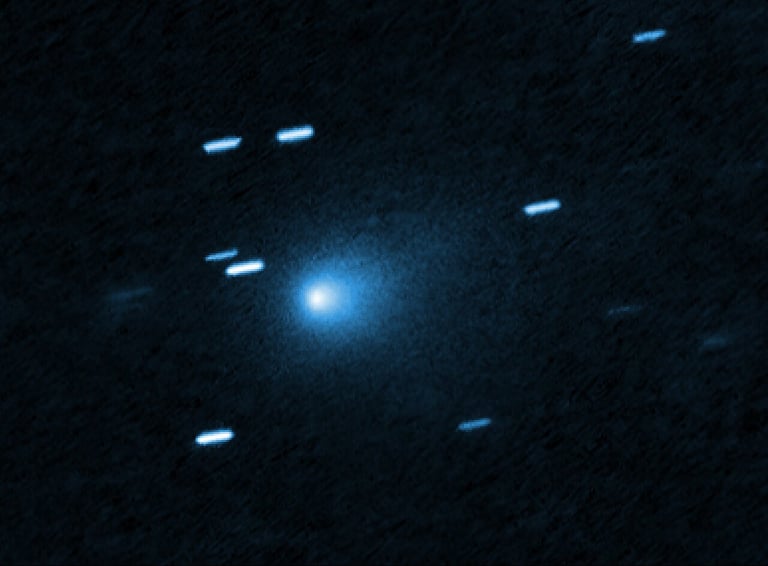


NASA's Hubble Space Telescope has captured the clearest image yet of interstellar comet 3I/ATLAS, revealing a teardrop-shaped dust cocoon around its icy nucleus, located 277 million miles from Earth.
Traveling at a speed of 130,000 mph, 3I/ATLAS will pass closer to Mars than to Earth, posing no threat to our planet.
The nucleus of the comet is estimated to be between 1,000 feet and 3.5 miles in diameter, although it cannot be directly observed.
A research paper detailing the findings from Hubble's observations will be published in The Astrophysical Journal Letters, with current access available on arXiv.
Multiple telescopes, including the James Webb Space Telescope, are studying the chemical composition of 3I/ATLAS, with visibility expected to last until September 2025.
The newly operational Vera C. Rubin Observatory is anticipated to observe between 5 to 50 more interstellar objects during its decade-long survey, enhancing our understanding of such celestial phenomena.
The European Space Agency is preparing the Comet Interceptor mission, set to launch in 2029, aimed at studying pristine comets and potentially intercepting interstellar objects.
The Hubble images of 3I/ATLAS are publicly available for further study by researchers and enthusiasts.
Hubble has been operational for over 30 years, continuing to contribute to our understanding of the universe through international cooperation between NASA and the European Space Agency.
The origins of 3I/ATLAS remain uncertain, with astronomers noting the challenge of tracing its path, likening it to glimpsing a bullet for a brief moment.
Research suggests that 3I/ATLAS could be over 7.6 billion years old, making it potentially the oldest comet ever observed, surpassing the solar system's age of 4.6 billion years.
Discovered on July 1, 2025, by the Asteroid Terrestrial-impact Last Alert System (ATLAS), 3I/ATLAS is expected to remain visible until September 2025 before passing too close to the Sun.
Summary based on 16 sources
Get a daily email with more World News stories
Sources
Yahoo News • Aug 7, 2025
Hubble Space Telescope takes best picture yet of the comet visiting from another solar system
CNN • Aug 7, 2025
Hubble offers sharp new view of interstellar comet
Los Angeles Times • Aug 7, 2025
Hubble telescope takes best picture of comet from another solar system - Los Angeles Times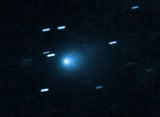
PBS News • Aug 7, 2025
Hubble Space Telescope captures image of comet visiting from another solar system