Amazon Faces Climate Crisis: Deforestation Drives 74.5% Rainfall Loss, 16.5% Temperature Surge
September 2, 2025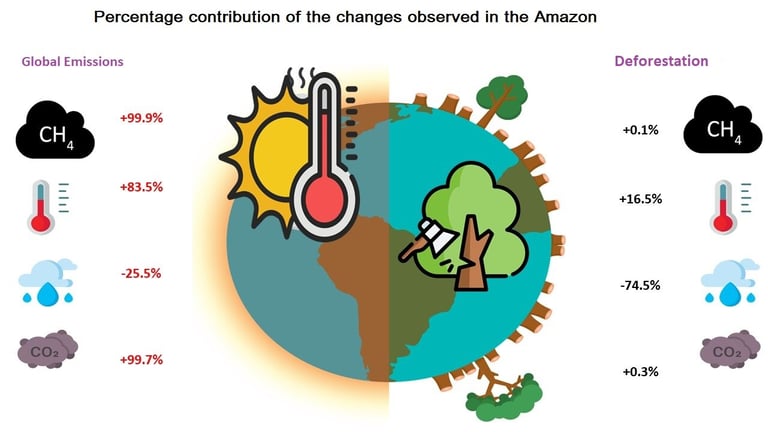


Understanding these interactions between deforestation and climate change is essential for predicting future climate trajectories in the Amazon and for developing policies to mitigate their impacts.
The study aimed to quantify the extent of the Amazon's transformation, which was previously understood qualitatively, using advanced methods like remote sensing and long-term data analysis.
Findings emphasize the importance of protecting the Amazon to maintain regional climate stability and prevent long-term ecological damage.
Over the past 35 years, greenhouse gases like CO2 and methane have risen significantly—by about 87 ppm and 173 ppb respectively—mainly driven by global emissions, with regional deforestation playing a smaller role.
Between 1985 and 2023, the Amazon lost approximately 14% of its native vegetation, mainly due to pasture conversion, though recent efforts have reduced deforestation to its second-lowest level during 2024-2025.
The research distinguished the effects of climate change from deforestation, revealing that early stages of forest loss cause the most intense local climate changes, highlighting the importance of forest preservation.
A recent study from the University of São Paulo highlights the profound impact of deforestation and climate change on the Amazon's climate, especially during the dry season, with deforestation responsible for about 74.5% of rainfall reduction and 16.5% of temperature rise.
The Amazon rainforest, the largest tropical forest globally, is vital not only for its biodiversity but also for stabilizing regional and global climate systems.
The research shows that global climate change has contributed predominantly (83.5%) to temperature increases of around 2°C, while deforestation accounts for roughly 16.5%, with more intense warming in heavily deforested areas.
If deforestation continues unchecked, models predict further declines in rainfall and increases in temperature, threatening the Amazon's resilience and potentially disrupting South American monsoon patterns, leading to more droughts and extreme weather events.
Since 1950, climate change has caused a temperature rise of about 0.15°C per decade in Amazonia, along with longer dry seasons that increase vulnerability to fires and droughts.
The ongoing transformation of the ecosystem due to deforestation exacerbates drought risk and environmental degradation, further threatening the region.
Summary based on 4 sources