Study Reveals Slavic Ancestry's Migration-Driven Roots Across Europe
September 3, 2025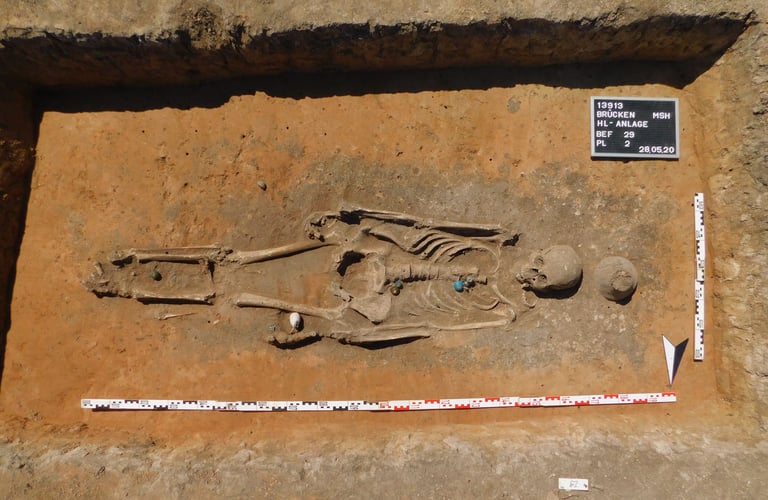


Slavic migrants moved across wide areas, causing significant demographic shifts in regions like Eastern Germany, Poland, and Croatia, involving entire families and no sex bias.
The Slavic expansion was characterized by demic diffusion and social flexibility, contributing to their success and the diverse cultural and linguistic landscape of Europe today.
The origin of Slavic ancestry is traced to populations in the Baltics, Poland, and Belarus, which exhibit the highest genetic similarity and shared haplotypes, especially those carrying R1a haplotypes common in modern Slavic populations.
Genetic analyses reveal that Slavic-associated groups across Europe share significant IBD segments and ancestry profiles, originating from a common source population in Northeastern Europe that migrated into Central and Southeastern Europe starting in the 6th century CE.
Ancient DNA studies confirm that the Slavic expansion was driven by large-scale population movements from a region between southern Belarus and central Ukraine, beginning in the 6th century.
Quantitative models estimate that between 65% and 93% of gene pools in regions like the Balkans, Germany, and Ukraine were replaced during the Slavic expansion, indicating extensive population turnover.
In Croatia and the Balkans, migrations resulted in mixed communities through intermarriage, with regional genetic variation reflecting a blend of local and Eastern European ancestries.
These findings challenge models of continuous local development, instead emphasizing migration and population replacement as key factors shaping Eastern Europe's genetic and cultural landscape.
The transition from Germanic to Slavic populations in Europe is linked to migrations after the Western Roman Empire's decline, with Slavs first appearing east of the Saale in the 6th century and expanding westward by the 7th.
In Poland, the population was almost entirely replaced by migrants from the East linked to modern Poles, Ukrainians, and Belarusians, overturning previous notions of population continuity.
During the Migration Period, regions like Elbe-Saale experienced highly diverse and cosmopolitan populations, reflecting extensive mobility and gene flow facilitated by the Roman Empire.
In Eastern Germany, over 85% of post-migration ancestry traces back to Eastern European arrivals, with the Sorbs as a Slavic-speaking minority retaining early Slavic genetic signatures.
A major demographic shift during the 6th to 8th centuries involved near-complete replacement of local genetic backgrounds with Eastern European (Baltic and Northeastern European) ancestry, indicating large-scale migration.
Ancient DNA analysis from 591 individuals across Europe between 600 and 800 CE shows significant genetic shifts, with high heterogeneity and diverse origins, including non-local Southern European ancestry in Eastern Germany.
Genetic evidence from Moravia, Czechia, confirms a demographic shift linked to Slavic cultural changes, with genetic ties to Northeastern Europe from the 7th to 10th centuries.
Summary based on 2 sources
Get a daily email with more Science stories
Sources
Nature • Sep 3, 2025
Ancient DNA connects large-scale migration with the spread of Slavs
Phys.org • Sep 3, 2025
How the Slavic migration reshaped Central and Eastern Europe