Magnetic White Dwarf Challenges Stellar Outflow Theories with Persistent Bow Shock
January 12, 2026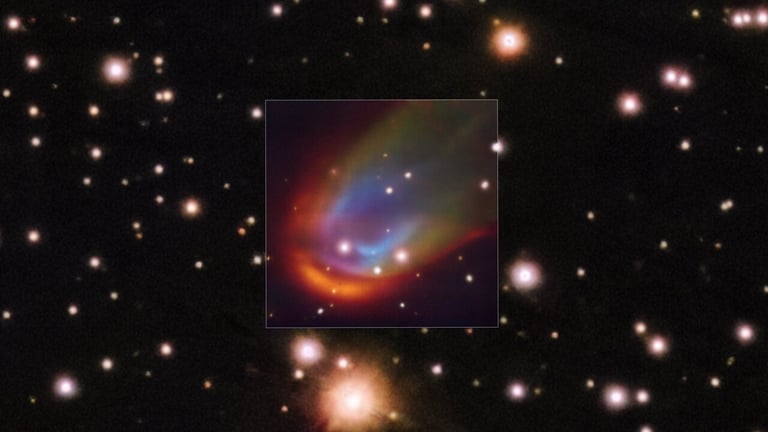

A diskless, magnetized white dwarf in a close binary shows a persistent bow shock powered by a strong magnetic field that channels material directly from its companion, challenging the notion that a disk is necessary for such outflows.
RXJ0528+2838 exhibits a long-lasting bow shock around a diskless white dwarf, a surprising finding that questions how dead stars interact with their surroundings.
Scientists propose a hidden energy source—likely the magnetic field—as a plausible driver of the outflow, but the exact mechanism remains unknown and requires further study of similar systems.
Initial detection used the Isaac Newton Telescope, with the ESO Very Large Telescope and its MUSE instrument subsequently mapping the bow shock in detail to confirm its association with the binary.
A consortium of researchers and institutions from the UK, Poland, Italy, Spain, and South Africa is listed, and media contact information is provided.
Future work includes studying more binary systems to clarify the phenomenon, with plans for the Extremely Large Telescope to map and detect fainter, similar systems.
The upcoming ELT could enable broader surveys that map these diskless outflows in greater detail, potentially revealing how common the phenomenon is.
Nature Astronomy highlights this discovery as exposing a gap in understanding how magnetic fields influence outflows and disk formation in close binaries.
The bow shock's shape and composition, mapped with MUSE, confirm the outflow originates from the binary system and is not from an external nebula, supporting a diskless mechanism.
If magnetic-field driving is confirmed, it would expand our understanding of matter transport and outflow generation in extreme binary systems without accretion disks.
The study suggests that existing models of stellar evolution and binary interaction may need revision to account for magnetic-field–driven outflows.
Ongoing observations and theory are needed to determine whether the magnetic-field hypothesis can fully explain the observed, long-lived bow shock.
Summary based on 4 sources
Get a daily email with more Science stories
Sources
Gizmodo • Jan 12, 2026
This Dead Star With a Glowing Shock Wave Shouldn’t Exist
Phys.org • Jan 12, 2026
Persistent shock wave around dead star puzzles astronomers
ScienceAlert • Jan 12, 2026
Rainbow Discovered Around a Nearby Dead Star Puzzles Scientists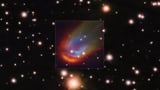
www.eso.org • Jan 12, 2026
Astronomers surprised by mysterious shock wave around dead star