Revolutionary Revoice Choker Empowers Stroke Survivors with AI-Driven Speech Decoding
January 19, 2026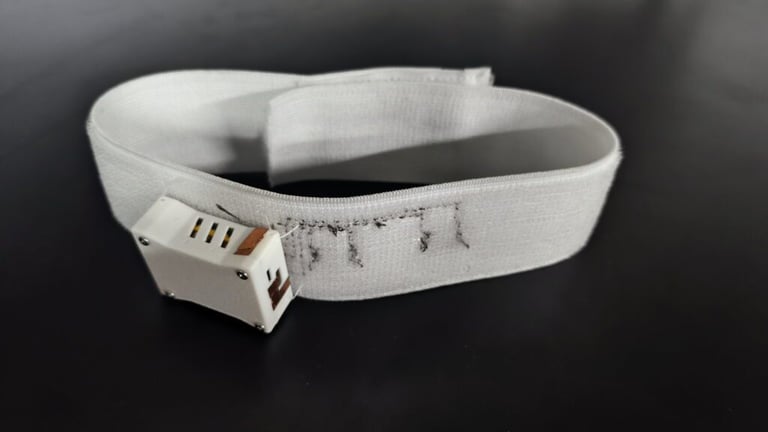


In a small trial, participants reported a 55% increase in satisfaction, with the study published in Nature Communications and plans for further research to validate efficacy and identify beneficiaries.
The same results indicate meaningful improvements in perceived communication ability and independence for stroke survivors.
The Nature Communications study suggests potential benefits for other conditions such as Parkinson’s disease and motor neuron disease beyond stroke.
Technical advance: knowledge distillation reduces the model size by transferring from a larger 1D ResNet-101 to a smaller 1D ResNet-18, cutting inference load by about 75.6% with a 0.9% accuracy drop to 91.3%.
A context-augmentation strategy with surrounding tokens enables high-accuracy 1D-CNN decoding and few-shot transfer learning from healthy individuals to patients, achieving about 92.2% token accuracy after 25 repetitions per word.
Fine-tuning on dysarthric stroke patient data yields a word error rate of 4.2% and a sentence error rate of 2.9%, with comprehensive comparisons to state-of-the-art wearables provided.
A polyurethane acrylate isolation layer mitigates crosstalk between silent-speech and pulse signals, boosting signal-to-interference ratio by over 20 dB when signals overlap.
A graphene-coated textile with a rigid isolation layer suppresses cross-axis interference, ensuring the dominant x-axis strain signal and demonstrating strong sensor performance.
A soft, washable Revoice choker developed at the University of Cambridge uses ultra-sensitive sensors and AI to decode speech from throat vibrations and pulse, helping stroke patients communicate naturally without brain implants.
The device interprets emotional state and environmental context like time of day and weather, and can expand words into sentences with a nod-based control.
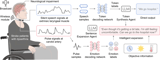
Revoice captures throat vibrations, heart rate, and other signals to translate into words and predict complete sentences, enabling silent mouthing and contextual interpretation of mood and surroundings.
Experts caution that findings are preliminary due to a small sample size and call for larger trials to confirm effectiveness and overall benefit.
Summary based on 11 sources
Get a daily email with more AI stories
Sources

Yahoo News UK • Jan 19, 2026
Stroke patients get their voice back thanks to new wearable device
Interesting Engineering • Jan 19, 2026
Cambridge team unveils AI wearable collar to help stroke survivors speak again
Medical Xpress • Jan 19, 2026
'Revoice' device gives stroke patients their voice back