Europe's AI Revolution: A Historic Chance to Lead Global Robotics and Manufacturing
January 21, 2026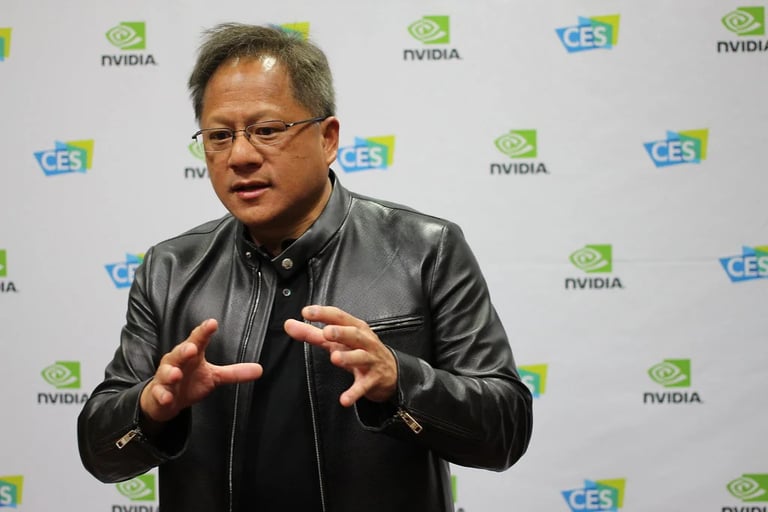

America’s AI vision requires a broad infrastructure buildout—energy, skilled labor, and long-term investment—besides chips, to enable large-scale industrial AI.
Over the next year, Europe’s policy commitments must translate into tangible hardware, power, and capital to enable sovereign AI capabilities and scale industrial AI.
Huang stressed that Europe must get serious about energy supply and infrastructure to fund a rich AI ecosystem, warning that high costs and limited access threaten ambitious AI manufacturing plans.
Without expanding energy supply and infrastructure, Europe’s AI-enabled manufacturing ambitions will be capped by grid and power constraints.
At the World Economic Forum, the message was clear: AI robotics represent a once-in-a-generation opportunity for Europe, leveraging its strong industrial and manufacturing base to lead in the next wave of technology.
By integrating industrial capability with artificial intelligence, Europe could advance physical AI and robotics and potentially outpace the current software-dominated era led by the U.S.
Huang warned that Europe faces a pivotal, once-in-a-generation moment to lead in AI and robotics or risk losing global relevance.
He described AI’s expansion as the largest infrastructure buildout in human history, with hundreds of billions already invested and trillions more needed across energy, data centers, and connectivity.
Europe’s data center share has fallen from 25% in 2015 to 15% in 2024, with grid constraints and energy costs nearly double those in the U.S., posing a bottleneck for AI adoption.
Policy responses include the EU AI Continent Action Plan to triple data center capacity within five to seven years, Britain’s 1 billion for computing infrastructure, France’s sovereignty-focused data center plans, and Germany’s Deutsche Telekom–Nvidia partnerships, along with four approved AI gigafactories valued at about $20 billion.
Big tech and investors are doubling down on robotics, with high-profile efforts from Tesla on humanoid robots and Google DeepMind’s robotics AI models, as robotics funding nears a record $26.5 billion in 2025.
The next AI wave is expected to reshape the physical world—machines, factories, logistics, and automation—beyond software alone.
Summary based on 3 sources
Get a daily email with more EU News stories
Sources


TradingView • Jan 21, 2026
Nvidia CEO Jensen Huang makes big call on Europe: ‘once-in-a-generation’ moment
Beijing Times • Jan 21, 2026
Nvidia’s Jensen Huang says robotics is Europe’s “once-in-a-generation” opportunity