Goethe's Amber Yields 40-Million-Year-Old Ant Fossil, Revealed Through 3D Imaging
January 26, 2026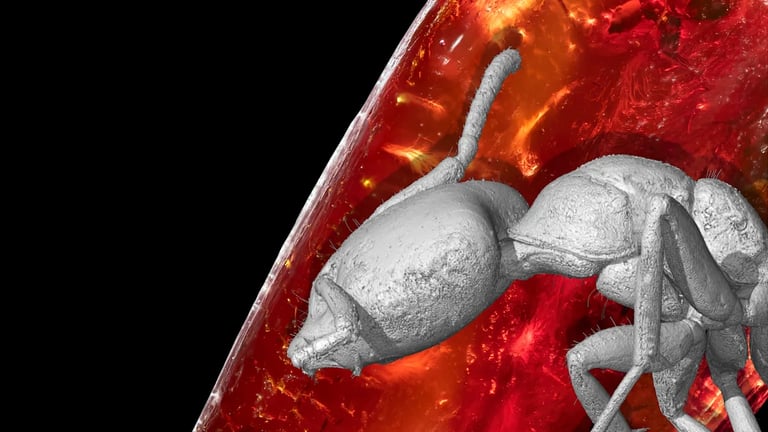

The ant is described in greater detail than before, thanks to the high preservation of its head and thorax within the Baltic amber.
Goethe’s historic interest in amber connects optics and color study to contemporary scientific value of his collection.
A 40-million-year-old ant fossil has been identified inside amber once owned by Johann Wolfgang von Goethe, using modern 3D imaging techniques.
A full preparation and 3D reconstruction of the specimen have been completed and published online, aiding global researchers in recognizing related fossils.
The specimen has been identified as the extinct species Ctenobethylus goepperti using modern imaging techniques since it is not visible to the naked eye.
Based on similarities to Liometopum, researchers infer the ant likely built large nests in trees, explaining why related ants are commonly found in amber.
The amber affords unprecedented interior views, revealing detailed structures in the ant’s head and thorax.
A 3D reconstruction of the ant has been created to facilitate identification and comparison of future fossils, enhancing understanding of its morphology and evolutionary relationships.
The 3D model is publicly accessible on Sketchfab, and the findings are published in Scientific Reports (2026) with DOI 10.1038/s41598-026-36004-4.
Goethe’s Baltic amber collection, which includes about 40 pieces, now contains three documented inclusions—a midge, a crane fly, and the ant—identified through advanced imaging.
Synchrotron micro-CT at DESY produced three-dimensional images of the insect inclusions, enabling detailed study beyond visual inspection.
Interactive 3D models of the amber inclusions have been created and are available online to help researchers identify and compare similar fossils.
Summary based on 3 sources