Optical Fiber Preform Market to Skyrocket, Reaching $22 Billion by 2031 Amid 5G and Data Center Boom
January 26, 2026

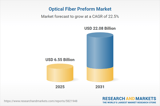
The Optical Fiber Preform Market is poised for rapid expansion, growing from about USD 6.55 billion in 2025 to roughly USD 22.08 billion by 2031, at a compound annual growth rate around 22%.
This surge is driven by rising demand for high-bandwidth communication infrastructure and the expansion of fiber-to-the-home/building networks, along with the ongoing rollouts of 5G and the growth of hyperscale data centers.
Faster 5G deployment and network densification are fueling demand for denser fiber backhaul and fronthaul links to support massive MIMO and higher frequency bands.
The full report is available for purchase or as a PDF through The Insight Partners, with contact details provided for inquiries.
Major manufacturers profiled include Hengtong Group, Fujikura, Furukawa Electric, Sterlite Technologies, Yangtze Optical Fibre and Cable, Sumitomo Electric, Prysmian Group, Heraeus, Corning, and OFS Fitel.
Additional profiles cover Broadcom, Cisco, Huawei, Fujitsu, Nokia, Juniper, Keysight, Agiltron, EMCORE, and Accelink, highlighting diverse players in the ecosystem.
Applications span Telecom, BFSI, and other sectors, with global coverage across North America, Europe, Asia-Pacific, South America, and the Middle East & Africa.
Recent developments include US-compliance enhancements by Sterlite Technologies and polarization-maintaining fibers from Coherent Corp, alongside ongoing eco-variant startup innovations and rising procurement activity as 2026 infrastructure upgrades roll out.
Wavelength categories cover 850, 1310, and 1550 nm (plus other bands) tailored for short, medium, and long-distance transmission across networks.
Market trends show a shift toward specialized multi-mode fiber preforms for short-range, ultra-fast data transmission, with a push toward environmentally sustainable production and greener data centers.
Optical Circuit Switching is gaining traction in AI clusters to manage east-west traffic and reduce electrical-to-optical conversions.
Summary based on 6 sources