Revolutionary Open-Source Platform Transforms AI Chatbot Development and Deployment
October 1, 2026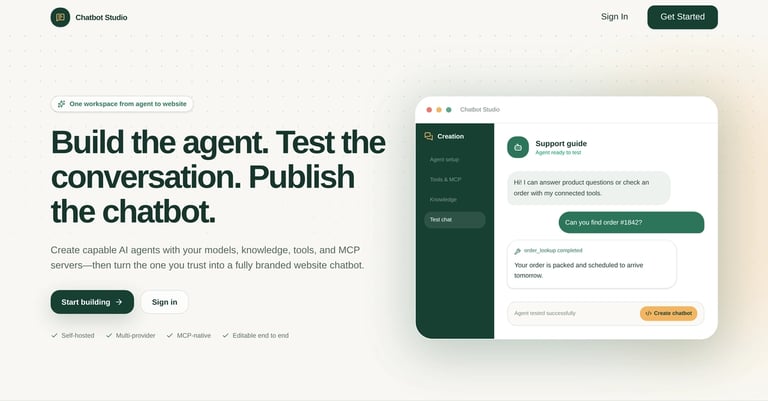

Human handoff supports routing conversations to administrator-managed queues (General, Technical, Sales, Billing) for timely human takeover when needed.
The platform supports multiple model providers and can connect to knowledge bases, memory, tools, MCP servers, and guardrails, with test chats validating consistency between test and production configurations.
Agent teams and visual workflows enable DAG-based, conditional, and persisted processes with human approvals and tracing, allowing complex orchestration beyond a single agent.
The exported chatbot is a framework-agnostic web component (chatbot-widget) using Shadow DOM, embeddable across HTML, React, Vue, Angular, and WordPress.
A core architectural principle keeps the agent and chatbot distinct: the agent owns models, tools, memory, knowledge, and guardrails, while the chatbot handles the channel and UI, enabling improvements without rebuilding chatbots.
The platform scales beyond the browser by integrating channel-specific transports like Baileys for WhatsApp, while keeping the agent as the central intelligence.
Evaluations and observability feature repeatable evaluation suites and metrics (token usage, cost, latency, tool calls, traces, errors, sessions, feedback) with a human-controlled prompt optimization workflow.
Knowledge bases can be external and reusable, supporting text, URLs, PDFs, DOCX, Markdown, CSV, and JSON, processed into retrievable embeddings.
Chatbot Studio is an open-source (MIT-licensed) platform for building, testing, and deploying AI agents, publishable as website chatbots or connected to channels like WhatsApp.
The core problem addressed is bridging the gap between building a chatbot and shipping a fully-featured agent platform with tools, memory, evaluation, observability, human handoff, and multi-provider support.
The Visual Chatbot Customizer shares the same rendering path as the shipped widget to ensure editor previews match runtime behavior, with extensive UI and behavior customization.
MCP (Model Context Protocol) support enables connecting agents to MCP servers via stdio, SSE, or streamable HTTP, promoting interoperable tooling over bespoke integrations.
Summary based on 1 source
Get a daily email with more Tech stories
Source
DEV Community • Oct 1, 2026
I Built an Open-Source Studio for Building, Testing, and Deploying AI Agents