KXCO Adopts ML-KEM-1024 Encryption as Default in Post-Quantum Packages, Aligns with Global Security Standards
October 10, 2026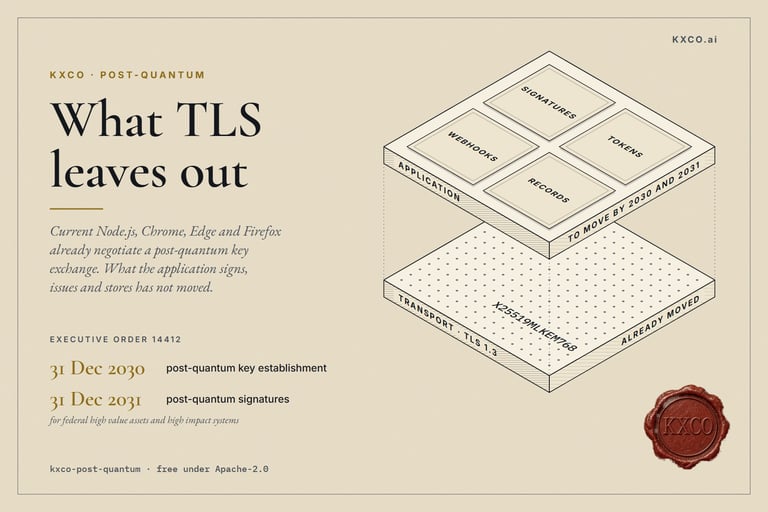

The core comparison shows RSA-2048 produces 256-byte signatures, while ML-DSA-44/65/87 generate signatures of 2,420, 3,309, and 4,627 bytes respectively, with larger public/private keys in ML-DSA, which has significant bandwidth and storage implications for TLS handshakes and certificate chains.
Migration costs include key exchange upgrades with minimal latency increase; however, certificate signatures with ML-DSA enlarge by about 8x, while overall latency may remain negligible in practice; SLH-DSA brings large signatures and higher signing energy, and IoT devices prioritize RAM over CPU optimization; an overview table contrasts bandwidth, compute, and chain size changes.
The practical impact centers on increased bandwidth and certificate storage from larger ML-DSA signatures, with migration costs spanning ASN.1 handling, certificate chain sizes, and HSM/KMS compatibility; cloud providers price ML-DSA operations similarly to other signatures, but infrastructure changes raise overall costs.
NIST has standardized PQC components and offers migration guidance, including phased transitions and hybrid configurations, with broader vendor adoption to maintain interoperability during the shift.
Post-quantum cryptography (PQC) covers algorithms that resist quantum attacks, including lattice-based, multivariate, and code-based approaches, which do not rely on factoring or discrete logarithms.
NIST and CNSA 2.0 timelines: NIST aims to deprecate RSA/ECC by roughly 2030–2035; CNSA 2.0 timelines for U.S. national-security systems target 2030 with exclusive use by 2033; most organizations should prepare for the 2030–2035 window.
kxco-post-quantum deployment guidance emphasizes broad compatibility with ACVP testing for post-quantum delivery, certifications, SBOMs, and provenance tooling to support new cryptographic configurations.
A four-era view outlines the progression toward quantum-ready cryptography, from the current NISQ era through early fault tolerance to the cryptographically relevant zone and full-scale quantum computing.
Existing ML-KEM-768 data and keys remain decryptable; older defaults stay functional, with explicit downgrade paths for legacy usage to ensure compatibility.
Nothing becomes stranded; hybrid TLS remains in use and compatibility is preserved across releases.
KXCO has made ML-KEM-1024 the default for new keys and encryption, with ML-DSA-87 as the signing key default in its post-quantum suite.
ML-DSA (CRYSTALS-Dilithium) was standardized by NIST as FIPS 204 in 2024, offering lattice-based security against quantum threats with parameter sets ML-DSA-44, -65, and -87 representing different security levels rather than fixed key sizes.
Summary based on 5 sources
Get a daily email with more Crypto stories
Sources
Live Trading News • Oct 10, 2026
KXCO's Free Post-Quantum Library Covers What TLS Leaves Out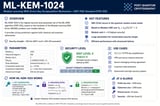
Live Trading News • Oct 11, 2026
KXCO Makes ML-KEM-1024 Its Default, Completing the CNSA 2.0 Algorithm Pair