Revolutionizing Quantum Research: New Catalog Unveils Thousands of Potential Twisted Bilayers for Twistronics
October 13, 2026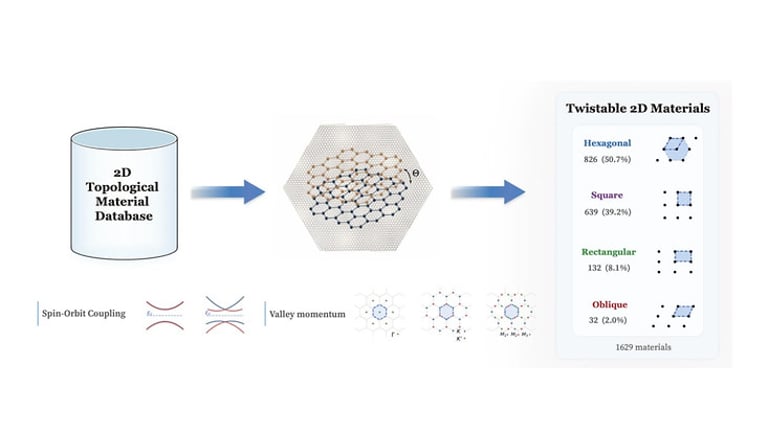

The monolayer catalog serves as a starting point for selecting layers to twist, highlighting thousands of potential twisted bilayers with features like topological and flat bands.
The approach shifts materials discovery from serendipity to a targeted, high-throughput search, providing a practical materials roadmap for exploring quantum states beyond current platforms.
A hafnium disulfide homobilayer derived from these materials is being studied at millikelvin temperatures to demonstrate the database’s immediate applicability.
The electronic structures, with and without topological characteristics, are publicly available to accelerate collaboration and discovery.
Princeton University and the Max Planck Institute for Structure and Dynamics of Matter collaborated to produce a catalog of 8,872 two-dimensional materials to advance twistronics research.
The Science study identifies 1,568 insulating and 61 semimetal candidates well-suited for creating new quantum simulators.
Experimental validation includes crystal growth and exfoliation, with some materials already reduced to single layers for testing twisted heterostructures and quantum behaviors.
Researchers emphasize that controlling material choice, twist angle, and electron density could reveal correlated and topological states not present in untwisted layers.
The catalog prioritizes layers whose electronic structures are simple enough to be modeled with continuum theories when twisted, enabling predictable quantum system design.
A companion database, the Twisted Bilayer Moiré Superlattice Database (TBMSD), contains over 600 computed twisted bilayers and complements the monolayer catalog.
Summary based on 1 source
Get a daily email with more Science stories
Source
Quantum Zeitgeist • Oct 12, 2026
MPSD Researchers Map Nearly 9,000 Atomically Thin Structures.