Breakthrough in Multi-Species Quantum Entanglement Extends Lifespan for Advanced Quantum Networks
October 16, 2026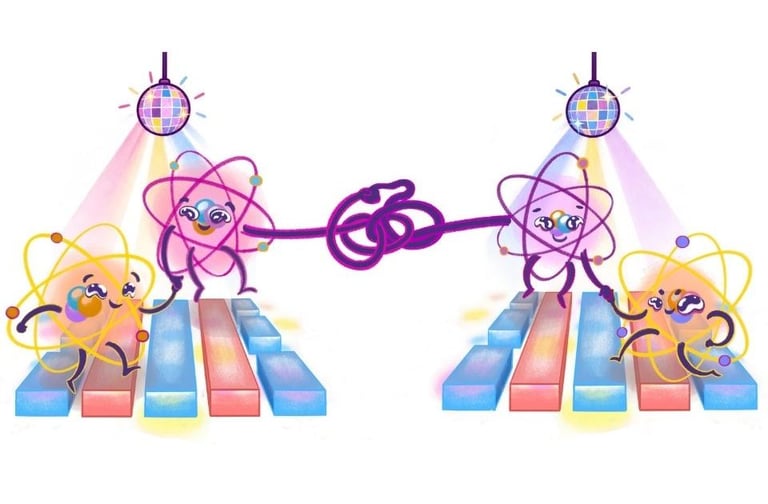

Oxford researchers have achieved a record 10-second entanglement between two atomic species, strontium and calcium, marking a major advance for distributed quantum computing.
The team demonstrated a heterogeneous quantum network that creates multipartite entangled states across trapped-ion modules using 88Sr+ and 43Ca+ ions, with shared states involving up to four atoms.
Calcium atoms extend the entanglement lifetime to over 10 seconds, a significant improvement over the millisecond scales typical when using strontium alone.
By separating networking and storage duties into different species, the work addresses a key challenge in distributed quantum computing and enables longer-lived distributed entanglement across a network.
The study, published in Physical Review Letters as Multipartite mixed-species entanglement over a quantum network, highlights potential applications in quantum sensing and timekeeping beyond computation.
Longer entanglement times strengthen prospects for multi-qubit gates, remote state sharing, and scalable quantum networks, including distributed quantum computation and remote clock comparisons.
Each node co-traps one 88Sr+ optical interface ion and one 43Ca+ memory qubit to mitigate decoherence from networking operations.
Photons at 422 nm emitted from Sr+ ions interfere at a central heralding station to generate remote entanglement, which is mapped onto Ca+ memory qubits via 402-nm Raman pulses that implement geometric phase gates and error-detected iSWAP operations.
Multi-species entanglement leverages the distinct advantages of different atomic species to advance computing, sensing, and timekeeping applications.
Demonstrations include 3-qubit GHZ states and various Sr+-Ca+ Bell states with fidelities around 93% to nearly 97% in certain configurations.
Ground-state Ca+ qubits show first-order magnetic field insensitivity around 0.5 mT, boosting robustness and extending entanglement lifetimes by over 100x relative to the generation time.
The work marks progress in controlling entanglement between different atomic species, a key step toward versatile quantum networks and technologies.
Summary based on 3 sources
Get a daily email with more Science stories
Sources
Quantum Zeitgeist • Oct 16, 2026
Strontium Links Atoms, Calcium Preserves Entanglement For Longer