Exploring the Diverse Landscape of Bacterial Defense Mechanisms Against Phages
October 21, 2026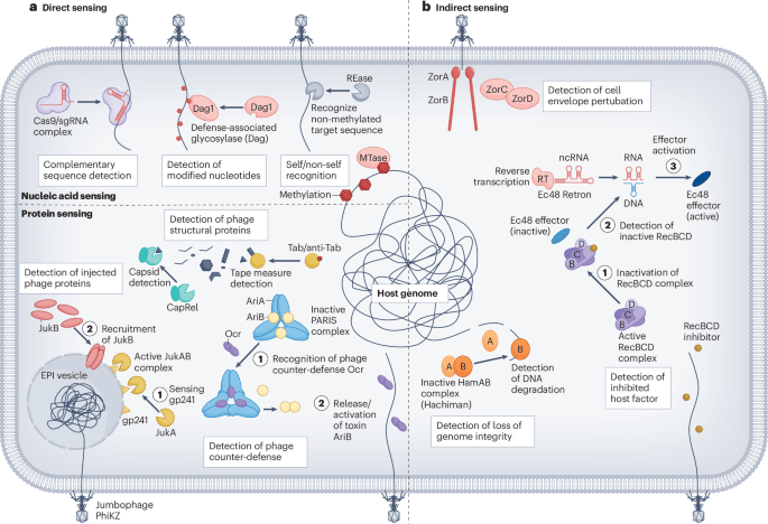

The central theme is that bacterial immunity against phages is diverse, involving CRISPR-Cas, restriction-modification, BREX, DISARM, retrons, and other novel defense mechanisms.
The material functions as a comprehensive bibliography and synthesis of the evolving landscape of prokaryotic antiviral defense, offering an in-depth overview of major systems, historical developments, and current directions.
The article provides a curated list of key publications on anti-phage defense systems in bacteria, highlighting foundational and recent findings across studies and journals.
Recent and forthcoming research up to 2026 describe structural bases, activation mechanisms, DNA recognition, and immune evasion strategies of these defense systems, signaling rapid mechanistic advances.
Subsequent works expand functional discovery and characterization of anti-phage systems across species and contexts, including E. coli pangenome analyses, chromosomal integrons, and mobile integrons encoding defenses.
Foundational understanding of CRISPR-Cas immunity and prokaryotic innate defenses by Gao et al. 2020 and Marraffini 2015 is complemented by details on systems like DISARM, Gabija, Zorya, Hachiman, and PARIS.
Doron et al. (2018) report a systematic discovery of anti-phage defense systems in the microbial pan-genome, illustrating the breadth of defense loci across bacteria.
The compilation highlights the interconnectedness of phage biology and bacterial defense, including phage satellites, prophage elements, and phage-induced stress responses shaping immunity.
Summary based on 1 source