Generative AI Revolutionizes Payroll: Enhancing Efficiency, Support, and Reporting
October 26, 2026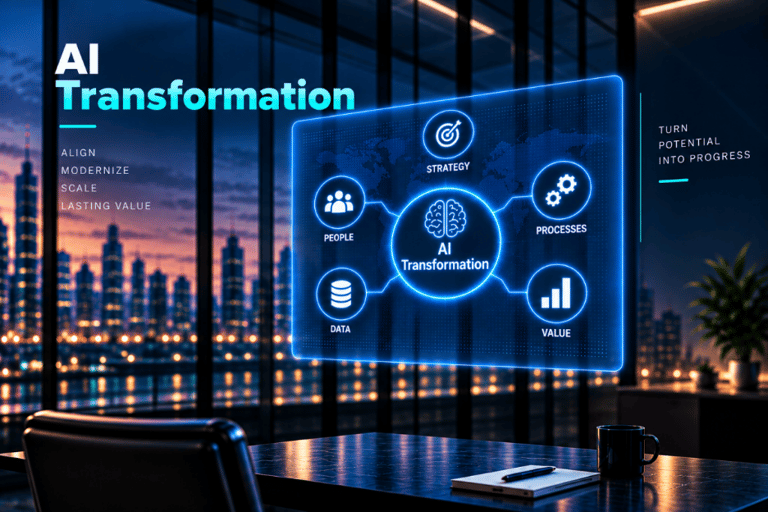

Applications of Generative AI in payroll include employee payroll support, payroll case management, exception management, payroll knowledge management, employee communications, and payroll reporting.
AI Transformation is a holistic redesign of payroll workflows, data foundations, and system integrations rather than deploying isolated AI tools.
AI Transformation reshapes payroll workflows by enabling coordinated intelligent systems that assist with routine information retrieval, documentation, and exception analysis, freeing specialists to tackle complex issues and governance.
To address fragmentation and manual work in payroll operations, Generative AI aims to speed access to information, cut routine inquiry handling time, and raise productivity while preserving accuracy and governance.
Looking ahead, Generative AI in Payroll will feature intelligent agents coordinating across enterprise systems, offering conversational access to costs and performance metrics, while continual workflow redesign, governance, and decision rights evolve with capabilities.
Generative AI in Payroll is deployed to simplify payroll administration, support employees, and boost reporting and knowledge management by interpreting natural-language inquiries, summarizing information, generating communications, and retrieving policies.
Business benefits include greater payroll productivity, faster employee service via self-service, improved exception management, better knowledge accessibility, and greater scalability of operations.
Implementation best practices involve defining challenges and outcomes, establishing baselines, simplifying workflows before automating, improving data quality and governance, integrating with related systems, enforcing role-based access control, maintaining human accountability, testing with realistic scenarios, preparing employees for AI-enabled processes, and measuring productivity and service improvements.
Value is measured by payroll performance improvements—such as faster inquiry resolution, increased productivity, quicker exception handling, cost reductions, and better service quality—anchored by baselines set before deployment.
A payroll AI implementation roadmap should begin with assessing current performance, identifying high-impact activities, and evaluating AI opportunities by value, feasibility, complexity, and risk; it should cover data readiness, integration, governance, training, and clearly defined use cases with measurable outcomes.
Common implementation challenges include fragmented data across HR, payroll, and finance; legacy systems; data reliability for AI outputs; privacy concerns; and the need for security controls, validation, and human oversight.
Core technologies supporting intelligent payroll include Generative AI, Machine Learning, Predictive Analytics, Intelligent Automation, and AI Agents, which together extend beyond traditional automation.
Summary based on 1 source
Get a daily email with more AI stories
Source

NERDBOT • Oct 26, 2026
Generative AI in Payroll: How AI Transformation Is Modernizing Payroll Operations