New Dwarf Planet Discovered Beyond Neptune by Vera Rubin Observatory
October 27, 2026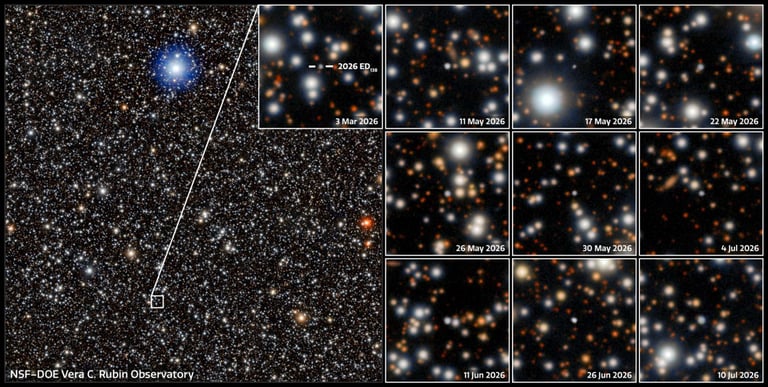

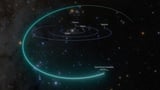
A object designated 2026 ED138 was discovered beyond Neptune by the Vera Rubin Observatory and is likely a dwarf planet, with an estimated diameter between 600 and 1500 kilometers that could be large enough to be spherical under its own gravity.
Rubin Observatory data are expanding knowledge of the Solar System and beyond, with scientists emphasizing the survey’s ability to reveal movement and change across vast datasets.
Contextual notes: Pluto is about 40 astronomical units from the Sun, and the IAU officially recognizes five dwarf planets: Pluto, Ceres, Eris, Haumea, and Makemake.
The discovery team described the process as connecting multiple observational datasets to confirm the object.
confirmation involved identifying roughly 30 archived observations dating back to 2016 and earlier precovery data from the Asteroid Institute, reinforcing the object’s existence and properties.
Rubin Observatory’s speed, depth, and precision enable backtracking through years of imagery to search for objects identified in real time, increasing chances of rediscovery or confirmation.
Matthew Holman of the Center for Astrophysics | Harvard & Smithsonian identified 2026 ED138 on October 13 by reprocessing Rubin data with a code he developed with Kevin Napier, with subsequent observations confirming the object across 20 nights between March 4 and July 11 that year.
Researchers verified the discovery by cross-checking multiple datasets from Rubin observations from 2016 to 2026, totaling dozens of observations to map its orbit.
The discovery was reported through outlets including the National Science Foundation and Scientific American, based on data analysis by Matthew Holman and Kevin Napier and others.
The object is too faint for naked-eye visibility but detectable by capable amateurs with guidance, and Rubin’s all-sky survey every three days facilitated the discovery.
Follow-up observations by other observatories are planned to determine its nature, and the public can explore the discovery via Orbitviewer, an interactive web app.
Rubin Observatory sits on Cerro Pachón in northern Chile and is primarily US-funded; it began regular operations only recently before these findings.
Summary based on 15 sources
Get a daily email with more Science stories
Sources
Scientific American • Oct 27, 2026
The Vera C. Rubin Observatory may have just discovered our solar system’s sixth dwarf planet
National Science Foundation • Oct 27, 2026
New dwarf planet candidate discovered by NSF–DOE Rubin Observatory
GeekWire • Oct 28, 2026
A new pal for Pluto? Rubin Observatory finds its first dwarf planet candidate