Independent Analysis Confirms M87*’s Ring-Shaped Black Hole Image
November 11, 2026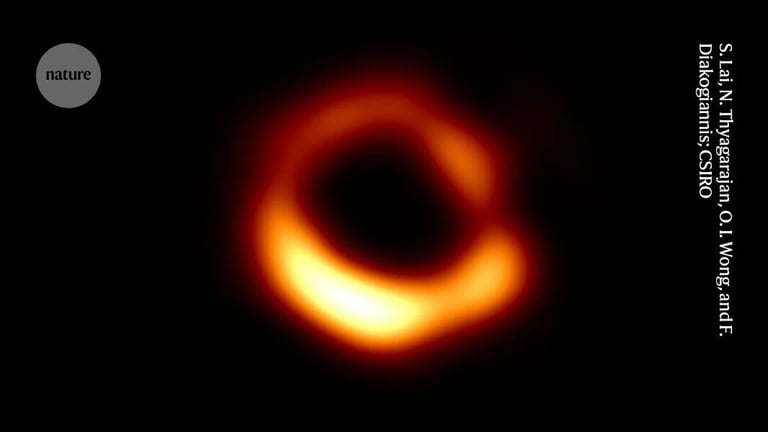

An independent analysis published in Nature on November 11 has largely confirmed the Event Horizon Telescope’s 2019 image of M87*, the supermassive black hole at the center of the M87 galaxy, producing a ring-shaped image strikingly similar to the original and adding confidence in the result and general relativity.
The Event Horizon Telescope links radio telescopes across several continents to achieve the resolution of an Earth-sized dish, but its sparse measurements and atmospheric interference make image reconstruction challenging.
That difficulty has fueled debate over whether the ring could be an artifact of image-processing choices: most analyses recovered a ring, but one study published in 2022 showed a blob of radio emission instead.
To test the result independently, the researchers used GenDIReCT, a machine-learning reconstruction method that combines measurements from triplets of telescopes to reduce calibration and atmospheric errors; it was not given a prior image or assumptions about what a black hole should look like.
The team also trained its algorithm on images unrelated to black holes, helping limit bias from expectations about M87*’s appearance, and used a separate, traditional statistical imaging method as a further check.
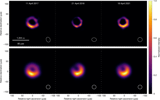
Across observing periods and image settings, the analysis repeatedly recovered a compact ring about 40 microarcseconds across, particularly in the best-covered datasets.
The ring’s diameter was consistent across two measurement approaches: 42.2 ± 1.5 microarcseconds from image reconstructions and 42.3 ± 1.1 microarcseconds from a geometric fit to the telescope data.
The ring’s orientation and diameter remained relatively stable, while its width, central brightness and brightness variations around the circumference changed more with the method and data coverage, making those details less reliable as intrinsic properties.
Using the ring’s measured diameter and an estimated distance of 16.8 megaparsecs, the researchers calculated M87*’s mass at 6.5 ± 0.5 billion times the Sun’s, consistent with stellar-dynamical estimates.
Comparisons with simulated images favor an inclination of about 20 degrees, consistent with an independently estimated viewing angle for the jet, but the analysis does not establish the black hole’s spin magnitude.
Event Horizon Telescope Collaboration director Dr. Laurent Loinard welcomed the independent result, saying it supports confidence in the published findings and adds tools for researchers.
Project leader Dr. Nithyanandan Thyagarajan said the approach could also help combine sensor measurements in areas such as medical imaging and earthquake mapping.
Summary based on 6 sources
Get a daily email with more Science stories
Sources
Nature • Nov 11, 2026
Independent interferometric observable confirms black hole shadow in M87*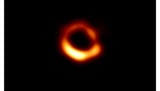
theregister • Nov 11, 2026
Scientists check their work and confirm it with update on iconic black hole image
Phys.org • Nov 12, 2026
Independent technique validates landmark M87* image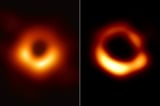
New Scientist • Nov 11, 2026
Re-analysis of black hole data proves iconic ring shape really is there